
Ellipse/Proofs
The Derivation of the Cartesian form for an ellipse is simple and instructive. An ellipse is defined as a the loci of points equidistant to two fixed points called the foci. Assuming that the foci are located at (-c,0) and (c,0) (ie. the ellipse is centered at (0,0)) then the sum of the distance between any point (x,y) and the two foci is constant.
If (x,y) is any point on the ellipse and if d1 is the distance between (x,y) and (-c,0) and d2 is the distance between (x,y) and (c,0), i.e.
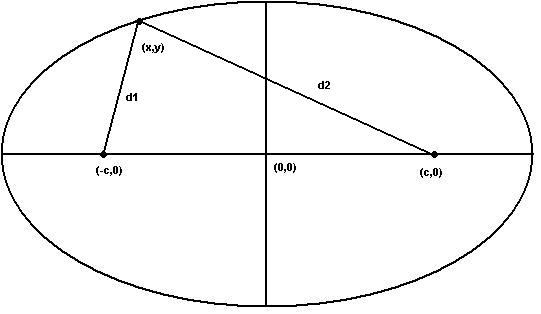
then we can define a
d1 + d2 = 2a
(a here is the semi-major axis, although this is irrelevant for the sake of the proof). From this simple definition we can derive the cartesian equation. Substituting:
$$\sqrt {(x+c)^2+y^2} + \sqrt {(x-c)^2+y^2} = 2a$$
To simplify we isolate the radical and square both sides.
$$\sqrt {(x+c)^2+y^2} = 2a - \sqrt {(x-c)^2+y^2}$$
$$(x+c)^2 + y^2 = \left ( 2a - \sqrt{(x-c)^2+y^2} \right )^2$$
$$(x+c)^2 + y^2 = 4a^2 - 4a\sqrt{(x-c)^2+y^2} + (x-c)^2 +y^2$$
Solving for the root and simplifying:
$$\sqrt{(x-c)^2+y^2} = -{1 \over 4a} ((x+c)^2+y^2-4a^2-(x-c)^2-y^2)$$
$$\sqrt{(x-c)^2+y^2} = -{1 \over 4a} (x^2 + 2xc + c^2 -4a^2 -x^2 +2xc -c^2)$$
$$\sqrt{(x-c)^2+y^2} = -{1 \over 4a} (4xc - 4a^2)$$
$$\sqrt{(x-c)^2+y^2} = a - {c \over a}x$$
A final squaring
$$(x-c)^2+y^2 = a^2 - 2cx + {c^2 \over a^2}x^2$$
$$x^2 - 2xc + c^2 + y^2 = a^2 -2xc + {c^2 \over a^2}x^2$$
$$x^2 + c^2 + y^2 = a^2 + {c^2 \over a^2}x^2$$
Grouping the x-terms and dividing with a2 − c2
$$x^2 \left( 1 - {c^2 \over a^2} \right) + y^2 = a^2 - c^2$$
$$x^2 \left( {a^2 - c^2 \over a^2} \right) + y^2 = a^2 - c^2$$
$${x^2 \over a^2} + {y^2 \over a^2-c^2} = 1$$
If x = 0 then
$$d_1 = d_2 = a = \sqrt {c^2+b^2}$$
(where b is the semi-minor axis)
Therefore we can substitute
b2 = a2 − c2
And we have our desired equation:
$${x^2 \over a^2} + {y^2 \over b^2} = 1$$