
Eight Dimensional E-Learning Framework
Successfully de-orphaned! Wikiproject Orphanage: You can help!
Eight Dimensional E-Learning Framework
Overview
As public and private educational institutions, corporations and government agencies transfer their courses and professional development training from traditional, on site instruction to web-based instruction, a research-based framework should be employed to guide the design, development and implementation of online programs.
With the advancement of e-learning in the past decade, several successful e-learning frameworks have been developed, including:
- California E-Learning Framework
- e-Learning Planning Framework
- Joint Information Systems Committee (JISC) Framework
- ACL e-Learning Positioning Statement
- E-learning Maturity Model
- The Common Framework for E-Learning Quality
- Eight Dimensional E-Learning Framework
Aligning organizational training goals and plans towards an e-learning design framework can benefit the stakeholders (i.e., administrators, designers, developers, and users), as well as improve the overall success and effectiveness of the program. Existing e-learning programs hoping to streamline, modernize, or reform current practices and systems can utilize one of the aforementioned frameworks to ensure e-learning success.
AbOUT the Framework
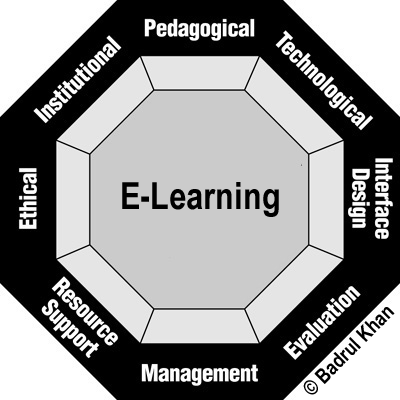 The eight dimensional E-Learning Framework, developed by Dr. Badrul Khan, is an organizing structure e-learning professionals, instructional designers, and educational technologists can use to establish, create, and maintain successful e-learning programs and initiatives. This framework identifies the BOUNDARIES of the e-learning environment to ensure that desired learning outcomes are achieved. The framework does not constitute a model because it does not prescribe a specific process for developing e-learning environments. However, it does take into consideration the design, development, delivery, and evaluation of web-based and hybrid instruction and can provide guidance in:
- planning and designing e-learning and blended-learning materials
- organizing resources for e-learning, blended, and simulated virtual-learning environments
- designing distributed learning systems for corporations, public and private universities, virtual universities and cyber schools
- designing Learning Management Systems and comprehensive authoring systems
- evaluating e-learning, blended-learning courses, and programs
- evaluating e-learning authoring tools/systems, LMS and LCMS
History
With the publication of Web-Based Instruction in 1997, the E-Learning Framework was developed as a response to questions from readers requesting to see exemplars of effective Web-based instruction as defined in the book. Unfortunately, in 1997, few exceptional models existed for institutions to emulate.
Between 1997-2005, with input from instructors, learners, trainers, administrators and other e-learning support services staff, an eight dimensional framework for e-learning emerged. Since then, the E-Learning Framework has been reviewed by scholars and practitioners from around the world, including e-learning experts from USA, Canada, UK, Australia, New Zealand, Netherlands, South Africa, Turkey, Korea and China.
Framework Dimensions
The E-Learning Framework consists of 8 dimensions, sometimes referred to as factors. Each dimension represents a category of issues that need to be considered in order to create successful e-learning experiences. The framework offers a practical and detailed checklist to serve as a self assessment instrument for institutions to evaluate their e-learning readiness or their opportunities for growth. A checklist is provided for each dimension and it includes 50 - 70 questions per dimension. The checklist does not include a scoring system, it just serves as an instrument to verify that each dimension is cultivated.
Pedagogical Dimension
The pedagogical dimension is concerned with the principles and methods of instruction (i.e., teaching and learning). It addresses how the content of a course is designed; identifies the learner's needs; and how the learning objectives will be achieved. This dimension also addresses the delivery method for the course activities and the appropriateness of the online environment for achieving the learning goals of its intended audience. When strictly face-to-face or online approaches are not feasible, the pedagogical dimension addresses the issues that enable stakeholders to prescribe alternatives, including a blended instructional approach that combines elements of on-site and online instruction. The Pedagogical Dimension is broken down into the following five sub-dimensions. Each of these sub-dimensions address a host of pedagogical issues:
- Content Analysis
- Audience Analysis
- Goal Analysis
- Design Approach
- Methods and Strategies
Technological Dimension
The technological dimension addresses issues pertaining to hardware, software, and infrastructure planning. It also addresses issues pertaining to the selection of the most suitable learning management system (LMS) and communication tools (i.e., audio and video conferencing platforms) for achieving the institution's learning goals and objectives. Technical requirements such as the server capacities, bandwidth, security, backups, and other infrastructure issues are also addressed. The technological dimension is broken down into three sub-dimensions, each with their own sets of issues:
- Infrastructure Planning
- Hardware
- Software
Interface Design Dimension
The interface design dimension addresses issues pertaining to the overall look and feel of an e-learning course or program. Design considerations include page and site design, navigation, accessibility and usability issues. For online learners the user interface is the first thing they see when they login to a course. The first impression students get from a course or program is often based on the site's user interface appearance and ease of use. The interface design dimension has major 5 sub-dimensions:
- Page and Site Design
- Content Design
- Navigation
- Accessibility
- Usability Testing
Evaluation Dimension
The evaluation dimension addresses the assessment of learners as well as evaluation of the instruction and learning environment. This dimension also addresses the creation of rubrics to evaluate each of the areas involved in the e-learning strategy; including rubrics for the persons involved in the design process (i.e., the planning team, design team, production team, and evaluation team); rubrics for each of the instructional design processes (i.e., planning, design, development and evaluation); and, rubrics for each of the outcomes (i.e., the project plan, storyboard and course materials). The evaluation dimension has five sub-dimensions:
- Assessment of Learners
- Evaluation of Instruction and Learning Environment
- Evaluation of Content Development Processes
- Evaluation of Individuals Involved in the Content Development Process
- Evaluation of E-Leaning at the Program and Institutional Levels
Management Dimension
The management dimension addresses the continuation, updating, and upkeep of the learning environment. This continuation May Be used to determine whether or not the e-learning atmosphere is performing adequately, and whether or not the instruction is meeting its intent. This dimension also addresses issues of quality control, budgeting, staffing, security, and scheduling. The management dimension is broken down into three major sub-dimensions:
- Managing People, Processes and Products
- Managing E-Learning Content Development
- Managing the E-Learning Environment
Resource Support Dimension
The resource support dimension considers all of the technical and human resources support required to create meaningful and successful online learning environments. Examples of the support services include web-based and telephone technical support, digital libraries, online tutorials, newsletters, journals, podcasts, glossaries, FAQs, among others. The resources and support services needed to support elearning programs are encompassed in the following sub-dimensions:
- Online Support
- Instructional/Counseling Support
- Technical Support
- Career Counseling Services
- Online and Offline Resources
Ethical Dimension
The ethical dimension addresses issues pertaining to social and political influence, diversity, bias, the digital divide, information accessibility, etiquette, and legal issues. Legal issues include privacy, plagiarism and copyright issues. The ethical dimension is broken down into the following sub-dimensions:
- Social and Cultural Diversity
- Bias and Political Issues
- Geographical Diversity
- Learner Diversity
- Digital Divide
- Etiquette
- Legal Issues
Institutional Dimension
The institutional dimension addresses issues of administrative affairs, academic affairs and student services related to e-learning. Administrative affairs issues relate to admissions, financial aid, registration and payment, informational technology services, graduation, and grades. Academic Affairs refers to accreditation, policy, instructional quality, faculty and support staff, and class size. Student services is a wide field that covers everything from counseling and library support to book store, internships, and alumni affairs. Before a fully online program is launched, each of the aforementioned issues must be addressed for a smooth implementation. Online students should not be required to set foot on campus to participate in or take advantage of student services. The institutional dimension is broken down into three major categories or sub-dimensions:
- Administrative Affairs
- Academic Affairs
- Student Services
See also
- E-Learning
- Instructional Design
- Framework Oriented Design
- Web-Based Instruction
- Interface Design
- Distance Education
- Virtual Learning Environments
- User Interface Design
References