
E L Short
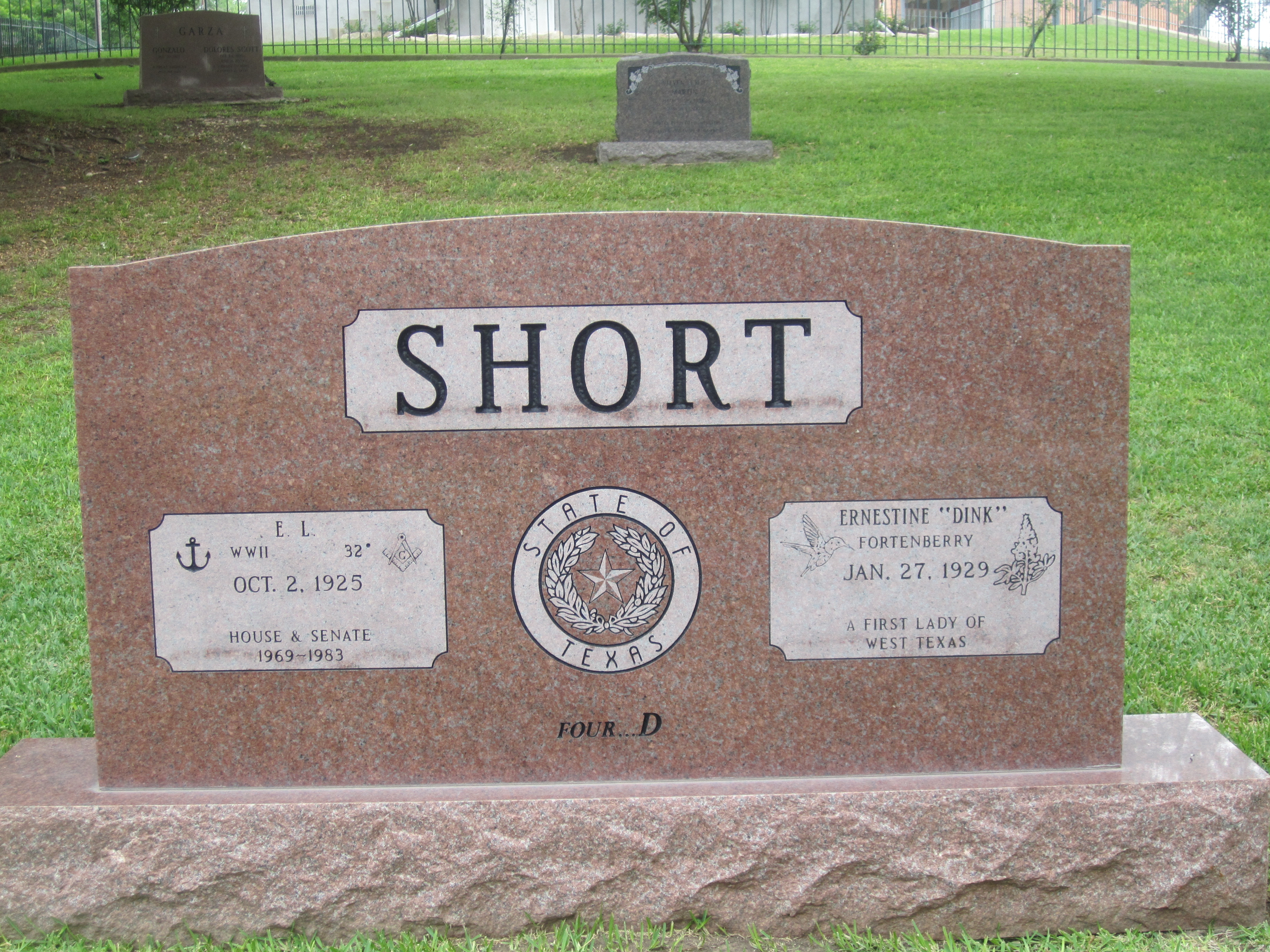
E L Short (born October 2, 1925) is a farmer, rancher, and businessman from Tahoka in Lynn County, Texas, who is a former Democratic member of both houses of the Texas State Legislature.
Background
Short (the E L stands for nothing) was born in Grassland in Lynn County to Cleburne E. "Bert" Short (1897–1980), a farmer originally from Greenville, Texas, and the former Eva Lena McCord (1900–1989). Short graduated from Tahoka High School. Thereafter, he served in the United States Navy from 1943 to 1945, having been stationed on the California coast and then dispatched to mainland China. After the war, he attended for several semesters Texas A&M University in College Station.
In 1947, Short wed the former Ernestine "Dink" Fortenberry (born January 27, 1929), a native of Dawson County. The couple has four daughters, Vivian Bruns of Sierra Vista, Arizona, Patti Kilpatrick of Brownwood, Robin Taylor of Brownfield, Texas, and Leah Taylor of Tahoka. Except as in-laws, the husbands of Robin and Leah Taylor are otherwise unrelated. Short is United Methodist.
State representative
Short was elected to the Texas House of Representatives from then District 73 in a special runoff election held on August 8, 1969, to fill the vacancy created by the resignation on June 30 of Democrat Randall George Pendleton, then of Andrews. Nine candidates had entered the first round of balloting on July 22. Pendleton accepted appointment from Governor Preston E. Smith as the Director of State and Federal Relations in Washington, D.C. Short held the House seat for ten years and for a time chaired the Inter-Government Affairs Committee. In 1975, he garnered statewide attention by focusing on the deadly hazards of hydrogen sulfide following an explosion of the gas in Denver City, located in Yoakum and Gaines counties in his district. Short endorsed an investigation by the Texas Railroad Commission and urged that residents be warned "by knocking on doors if necessary" of the imminent danger stemming from the gas. Often one dies from the second inhalation of the gas, and a warning itself may be too late.
State senator

In 1978, Short was elected the Texas State Senate to succeed Kent Ronald Hance of Dimmitt, the seat of Castro County, who was instead elected to the United States House of Representatives to fill the seat vacated by the retiring George H. Mahon of Lubbock. Hance, then a Democrat, defeated the Republican choice, George W. Bush, who had beaten Jim Reese, the former mayor of Odessa, in a GOP runoff primary.
Meanwhile, Short's House seat was won by the Democrat Jim Rudd of Brownfield in Terry County.
Short was appointed by Lieutenant Governor Bill Hobby, the presiding officer of the state Senate, to serve on the Finance Committee. Short worked to increase funding for the nursing school at Texas Tech University in Lubbock. He pushed for passage of bills to require cotton buyers to register with the state and to permit oversized modular trucks hauling cotton to be ginned to continue using the highways, as such operations are seasonal in nature. He was the vice chairman of the Senate Agriculture Committee and in the 1981 legislative session worked to thwart passage of seven land-use bills.
Texas Monthly magazine named Short to the list of the "Ten Worst Legislators" in the 1981 session. Others negatively cited were Democrat Carlos Truan of Corpus Christi and Republican John N. Leedom of Dallas, the author of the "Texas Rainy Day Fund." Rated among the best in 1981 were future U.S. Representative Lloyd Doggett of Austin, one of the Senate's more liberal members, Speaker Bill W. Clayton of Springlake in Lamb County, and Ray Farabee of Wichita Falls, all Democrats.
After a term in the Senate, Short was narrowly unseated in the 1982 Democratic primary by John T. Montford, the district attorney of Lubbock County. Short lost even though he had carried twelve of the fourteen counties in the district, losing only Lubbock and Borden, a small rural county. Montford then defeated Jim Reese, the unsuccessful Republican congressional candidate from both 1976 and 1978. Short speculates that he would have defeated Montford had rains not suppressed the Ector County turnout, which was extremely low that year, and had not some conservatives in Odessa voted instead in the Republican primary, which then had a relatively small rate of participation. Though Short had worked successfully on the Senate Finance Committee to obtain funding for the Odessa branch of the Texas Tech Medical School, his effort did not yield the political dividend in the primary that he had expected.
In the Montford-Reese general election contest, Short endorsed no one. Short, considered a conservative Democrat, later switched affiliation to the GOP but after his time in elective politics had passed.
There is a political exhibit with some of Short's memorabilia at the Garza County Historical Museum in Post, Texas.