
Cut-insertion theorem
The Cut-insertion theorem, also known as Pellegrini's theorem, is a linear network theorem that allows transformation of a generic network N into another network N' that makes analysis simpler and for which the main properties are more apparent.
Statement
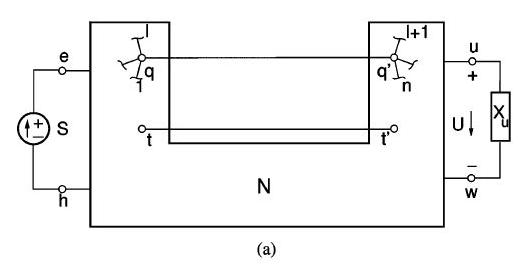
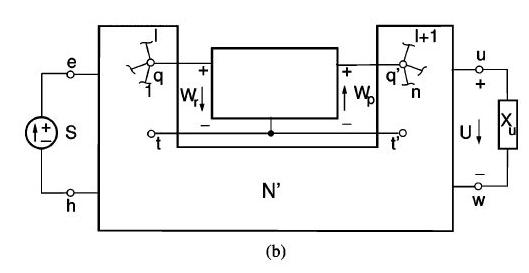
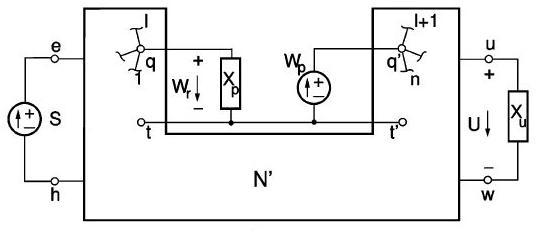 Let e, h, u, w, q=q', and t=t' be six arbitrary nodes of the network N and S be an independent voltage or current source connected between e and h, while U is the output quantity, either a voltage or current, relative to the branch with immittance Xu, connected between u and w. Let us now cut the qq' connection and insert a three-terminal circuit ("TTC") between The Two nodes q and q' and the node t=t', as in figure b (Wr and Wp are homogeneous quantities, voltages or currents, relative to the ports qt and q'q't' of the TTC).
In order for the two networks N and N' to be equivalent for any S, the two constraints Wr = Wp and $\bar{W_{r}}=\bar{W_{p}}$, where the overline indicates the dual quantity, are to be satisfied.
The above mentioned three-terminal circuit can be implemented, for example, connecting an ideal independent voltage or current source Wp between q' and t', and an immittance Xp between q and t.
Network functions
With reference to the network N', the following network functions can be defined:
$A\equiv\frac{U}{W_{p}}|_{S=0} \!\,$ ; $\beta\equiv\frac{W_{r}}{U} |_{S=0} \!\,$ ; $X_{i}\equiv\frac{W_{p}}{\bar{W_{p}}} |_{S=0} \!\,$
$\gamma\equiv\frac{U}{S} |_{W_{p}=0} \!\,$ ; $\alpha\equiv\frac{W_{r}}{S} |_{W_{p}=0} \!\,$ ; $\rho\equiv\frac{\bar{W_{p}}}{S} |_{W_{p}=0} \!\,$
from which, exploiting the Superposition theorem, we obtain:
Wr = αS + βAWp
$\bar{W_{p}}=\rho S+\frac{W_{p}}{X_{i}}$.
Therefore the first constraint for the equivalence of the networks is satisfied if $W_{p}=\frac{\alpha}{1-\beta A}S$.
Furthermore,
$\bar{W_{r}}=\frac{W_{r}}{X_{p}}$
$\bar{W_{p}}=\left(\frac{1}{X_{i}}+\frac{\rho}{\alpha}(1-\beta A)\right)W_{r}$
therefore the second constraint for the equivalence of the networks holds if $\frac{1}{X_{p}}=\frac{1}{X_{i}}+\frac{\rho}{\alpha}(1-\beta A)$
Transfer function
If we consider the expressions for the network functions γ and A, the first constraint for the equivalence of the networks, and we also consider that, as a result of the superposition principle, U = γS + AWp, the transfer function $A_{f}\equiv \frac{U}{S}$ is given by
$A_{f}=\frac{\alpha A}{1-\beta A}+\gamma$.
For the particular case of a feedback amplifier, the network functions α, γ and ρ take into account the nonidealities of such amplifier. In particular:
- α takes into account the nonideality of the comparison network at the input
- γ takes into account the non unidirectionality of the feedback chain
- ρ takes into account the non unidirectionality of the amplification chain.
If the amplifier can be considered ideal, i.e. if α = 1, ρ = 0 and γ = 0, the transfer function reduces to the known expression deriving from classical feedback theory:
$A_{f}=\frac{A}{1-\beta A}$.
Evaluation of the impedance and of the admittance between two nodes
The evaluation of the impedance (or of the admittance) between two nodes is made somewhat simpler by the cut-insertion theorem.
Impedance
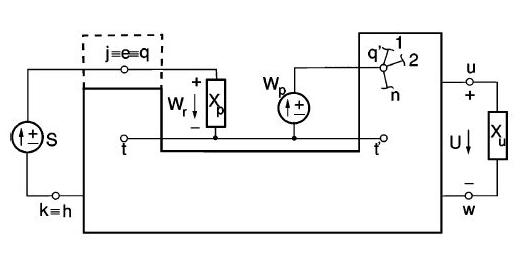 Let us insert a generic source S between the nodes j=e=q and k=h between which we want to evaluate the impedance Z. By performing a cut as shown in the figure, we notice that the immittance Xp is in series with S and the current through it is thus the same as that provided by S. If we choose an input voltage source Vs = S and, as a consequence, a current Is = S̄, and an impedance Zp = Xp, we can write the following relationships:
$Z=\frac{V_{s}}{I_{s}}=\frac{V_{s}}{I_{r}}=Z_{p}\frac{V_{s}}{V_{r}}=Z_{p}\frac{V_{s}}{V_{p}}=Z_{p}\frac{1-\beta A}{\alpha}$.
Considering that $\alpha=\frac{V_{r}}{V_{s}} |_{V_{p}=0}=\frac{Z_{p}}{Z_{p}+Z_{b}}$, where Zb is the impedance seen between the nodes k=h and t if remove Zp and short-circuit the voltage sources, we obtain the impedance Z between the nodes j and k in the form:
Z = (Zp+Zb)(1−βA)
Admittance
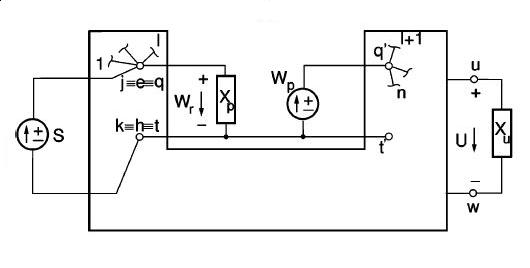 We proceed in a way analogous to the impedance case, but this time the cut will be as shown in the figure to the right, noticing that S is now in parallel to Xp. If we consider an input current source Is = S (as a result we have a voltage Vs = S̄) and an admittance Yp = Xp, the admittance Y between the nodes j and k can be computed as follows:
$Y=\frac{I_{s}}{V_{s}}=\frac{I_{s}}{V_{r}}=Y_{p}\frac{I_{s}}{I_{r}}=Y_{p}\frac{I_{s}}{I_{p}}=Y_{p}\frac{1-\beta A}{\alpha}$.
Considering that $\alpha=\frac{I_{r}}{I_{s}} |_{I_{p}=0}=\frac{Y_{p}}{Y_{p}+Y_{b}}$, where Yb is the admittance seen between the nodes k=h and t if we remove Yp and open the current sources, we obtain the admittance Y in the form:
Y = (Yp+Yb)(1−βA)
Comments
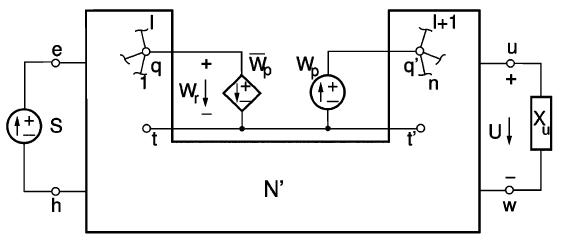 The implementation of the TTC with an independent source Wp and an immittance Xp is useful and intuitive for the calculation of the impedance between two nodes, but involves, as in the case of the other network functions, the difficulty of the calculation of Xp from the equivalence equation. Such difficulty can be avoided using a dependent source $\bar{W_{p}}$ in place of Xp and using the Blackman formula for the evaluation of X. Such an implementation of the TTC allows finding a feedback topology even in a network consisting of a voltage source and two impedances in series.
References
- B. Pellegrini, Considerations on the Feedback Theory, Alta Frequenza 41, 825 (1972).
- B. Pellegrini, Improved Feedback Theory, IEEE Transactions on Circuits and Systems 56, 1949 (2009).
See also
- Feedback
- Control theory