
Campaign of the mud
The Campaign of the Mud (, ) was a military expedition during the Arab–Khazar wars in the 8th century. Umayyad forces invaded Khazaria and engaged an army commanded personally by the Khagan. Medieval chroniclers gave the campaign its name because the battles were fought under torrential rains that turned the ground into impassable mud.
Dating
There are two historiographical traditions regarding the dating of the campaign. One tradition places it in 728 (110 AH) and associates it with Maslama ibn Abd al-Malik, while the other places it in 732 (114 AH) and associates it with Marwan ibn Muhammad. This ambiguity is inherited by modern historiography, where both dates appear depending on the primary sources relied upon by the author.
Campaign of 728
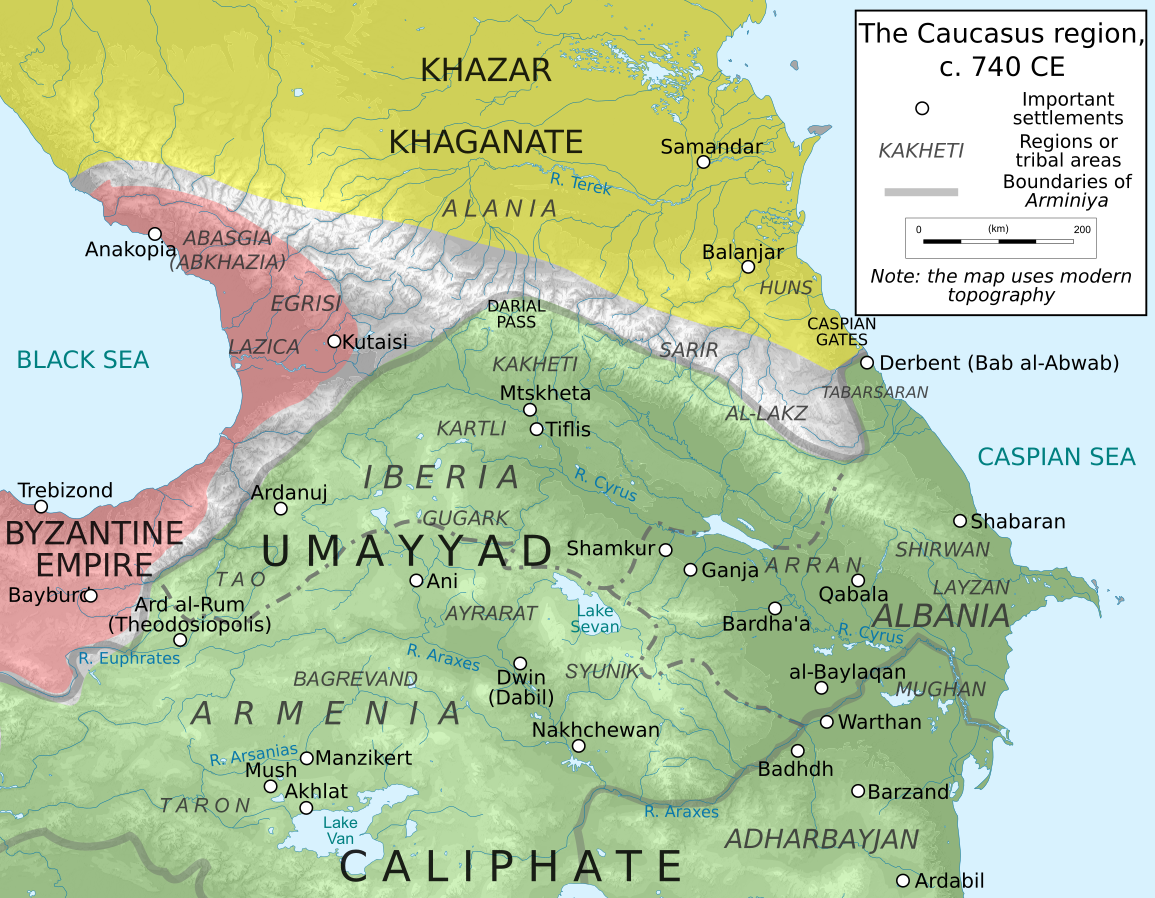 This version appears in early sources, specifically in the works of Khalifa ibn Khayyat and al-Tabari, as well as Ibn al-Athir and Michael the Syrian.
Maslama ibn Abd al-Malik, who had repelled a Khazar attack near the Darial Gorge the previous year, launched a preemptive strike. The Arab army passed through the Darial Gorge into Khazaria and engaged in combat that lasted approximately one month. According to Khalifa ibn Khayyat, the decisive battle between Maslama and the Khagan took place on Thursday, 17 Jumada al-Thani 728 (). Khalifa provides two versions of the battle's location, citing different informants: either near Derbent or near the Darial Gorge. According to al-Tabari, the fighting occurred on the Darial side.
Arab authors describe the outcome as successful; the Khagan (whose name is not preserved in the sources) was defeated and fled. However, Michael the Syrian writes the opposite, stating that the Arabs could not achieve victory and fled, abandoning their camp. The campaign was also noted in Byzantine sources, which is rare for these conflicts. Theophanes also reports the flight of the Arabs.
In any case, the result of the campaign was modest, as it did not significantly alter the balance of power. The Arab army returned via Lazica, passing a location known as the "Mosque of Dhu al-Qarnayn". Historian Anatoly Novoseltsev proposed an alternative route along the Caspian Sea coast, assuming the battle took place near Derbent, though this does not account for the arguments favoring the western route.
Al-Tabari describes the difficult conditions:
Campaign of 732
This version appears in Ibn A'tham al-Kufi and was borrowed from him by Bal'ami. Although not explicitly dated in the text, the sequence of events implies the beginning of 114 AH (732 AD).
Following Maslama's departure for Syria, Marwan ibn Muhammad was appointed the new governor of the northern provinces in early March. He immediately inspected the troops and, leading a 40,000-strong army, marched from Derbent to the Khazar city of Balanjar. The city was likely taken, and the Arabs advanced beyond it. The victory is described in standard terms: many enemy warriors were killed, and significant booty in livestock and prisoners was captured.
Regarding military actions on the Khazar front in 732/733, other sources are vague. Khalifa ibn Khayyat mentions that Marwan crossed a "River al-R.mm" (identification is speculative) and reached the lands of the Saqaliba (Slavs).
Ibn al-Athir stands apart; in his compilation, the campaign involving rain (though the specific term "Campaign of the Mud" is not used) is attributed to Maslama's previous campaign in 113 AH (731–732).
The specific detail about horse tails being cut off due to the accumulation of mud is found in the Georgian chronicle of Juansher Juansheriani, which describes Marwan's invasion of Lazica and Abkhazia around the same time:
Al-Kufi provides the Arabic account of this etymology:
See also
- Arab–Khazar wars
- Marwan II
- Second Arab–Khazar War