
Boys & Maughan
Boys & Maughan is a provincial solicitor's firm with a total strength including partners and staff of over 60, practising at its main office at India House, Hawley Street, Margate and from branches in the towns of Birchington, Broadstairs and Ramsgate, all of which lie within the Isle of Thanet in East Kent.
History
It has been possible to trace a solicitor named Boys dating back to 1803. He was John Boys who was born in 1782 and admitted as a solicitor in the Trinity term of 1803. He is the same John Boys who constructed Clifton Baths between 1824-8 at a cost of £15,000. Following his admission, he practised in partnership with Jacob Sawkins of Margate from 1803-05. From 1805-37 he practised alone and in 1837 he was joined in partnership by John Harvey Boys. John Boys was for many years Justice of the Peace (J.P.) for the County of Kent and died at Margate on 13 January 1861 aged 79. John Harvey Boys also practised as a solicitor in Margate until his death on 29 May 1870 aged 55. Toke Harvey Boys was the son of John Harvey Boys and was admitted as a solicitor in the Michaelmas term of 1870. Following his admission he joined the firm of Boys & Boys until 1874 when he appears to have practised on his own account.
The firm Boys & Maughan came into existence in 1902 when Toke Harvey Boys was joined in partnership by C.E. Maughan. Toke Harvey Boys died on 12 February 1916 aged 72 and is buried in St John's Church, Margate, where there is an alabaster monument to him on the wall. The successor to the practice was Mr. Cyril Collingwood Maughan of Margate, whose photograph is displayed in one of the front offices. He was also Clerk to the Justices for the Petty Sessional Division of Margate, which, until 1972 met in the Old Town Hall. J.S.C. (Jack) Maughan died in 1970, the last of his line to be a solicitor. The early 19th century Thanet map displayed on the lower staircase at India House is signed on the back by Toke Harvey Boys and by "Thomas Snooks, his Clerk". The crayon lines on the map appear to represent the path of the new railways, specifically the Ashford to Ramsgate (via Canterbury West) line and Kent Coast Line.
The firm currently has 12 partners, namely Jonathan Austin, Colin James, Peter Rodd, Robert Moulsdale, Andrew Baker, Allen Cox, Paul Reeves, Robert Bagley, Jonathan da Costa, Anthony Michael, Angela Turnbull and Richard Durrant. It has at various times in the past practised in Folkestone, Sandwich, Cliftonville and Canterbury.
India House
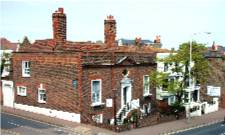 India House, Margate was built about 1766 by Captain John Gould (1722-84) a wealthy tea-planter as a copy of the house he had occupied in Calcutta. It is possibly unique in England as an example of anglo-Indian domestic architecture at the time. It would be interesting to learn if the house in Calcutta still survives.
India house is deceptive as it is larger than one first imagines. At the front of the building there are three rooms which rise to a height of two storeys, including the hall in the centre which is top-lit by the oval window above the handsome doorcase. Behind these front rooms there is a normal two-storey house. Inside, a certain grandeur is created by the high rooms. There is simple panelling of the period, a small elegant staircase, good fireplaces and an arch in the hall, which marks the division between the one and two-storey sections of the building. The building has been carefully maintained: recent improvements have included the front garden wall and wrought iron work and in 1989, the erection of a lamp post and hanging sign when the building attracted a Town Pride Award made by the Margate Civic Society. Original glazing bars no longer remain on the windows.
Captain Gould lived for many years in Calcutta. In 1759 he was appointed a Commissioner for Restitution following the Siege of Calcutta in 1756, and he was an Alderman as well. He finally returned to England in 1766 and, after his death in 1784, was buried in St. Leonard's Church, Upper Deal. His house and other property in Calcutta was left to his Portuguese-Indian wife, who had remained there. India House and some property at Deal were left to his natural son by his housekeeper at Margate.
After Gould's death India house was used as the local office of the East India Company.
During the 19th century at various times it was the private residence of Mr. Chippendale, a local banker, Mrs. French (1841) and Mr. Green, a wine merchant.
In 1897 it was the home of Phyllis Broughton, a famous Gaiety actress who first appeared in the Canterbury Music Hall, London, in 1876. She then progressed to musical comedy in the Gaiety Theatre, London in Aldwych in 1880 appearing in many such plays including The Earl and the Girl in 1903. She was one of the famous "Gaiety Girls", of whom thousands of postcards were sold at the turn of the twentieth century.
An interesting sidelight is that Dr. Thomson, a Margate doctor, had loved Phyllis Broughton for many years. At last when they were both nearly 70, they finally married and had two years of happiness before he died in 1924.
Margate Town Council had their meetings in the premises in the 1890s when their own Council Chamber in the Town Hall was under repair. In 1905 Dr. Harnett, Resident Surgeon at The Royal Sea Bathing Hospital died here. In 1917 the house was occupied by Dr. W.C. Esse, for many years Chief Physician at the Royal Hospital Chelsea.
Boys & Maughan have occupied India House since 1920. In 1976 they unlocked the front entrance which had been closed for over 50 years. The entrance had previously been to the side in New Street. This has now been blocked up as has an original doorway built into the garden wall.
External links
- Official site
- Margate Architecture
- St Leonard's Church, Deal
- St John's Church, Margate
- Margate Civic Society