
Blebbishield emergency program
Blebbishield emergency program is a process which acts as a last line of defense for cancer stem cells after induction of apoptosis where the apoptotic blebs fuse to shield the cells from the destructive force of apoptosis by forming blebbishields. Blebbishields in turn fuse to each other and generate cancer stem cell spheres, essentially shifting the balance of dying cells back towards survival. 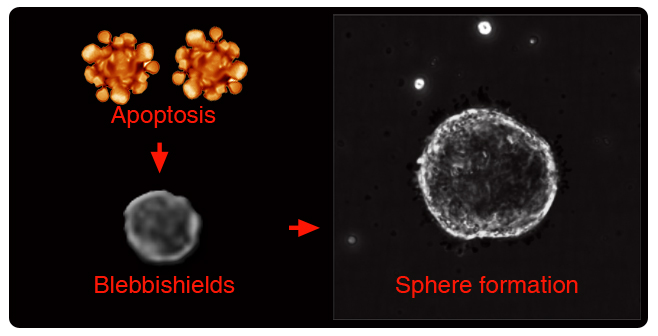
Discovery
Blebbishields were first identified in human bladder cancer cell line RT4 (HTB-2: ATCC), referred to as RT4P (RT4 parent) in the initial report.
Blebbishields and membrane fusion
Almost every cell type is capable of undergoing apoptosis, a process in which the plasma membrane undergoes blebbing followed by orderly deconstruction of cells. Cancer stem cells have the extra-ordinary ability to reconstruct blebbishields from these apoptotic blebs by bleb-bleb fusion and form stem cell spheres by sub-sequent blebbishield-blebbishield fusion. The involvement of membrane fusion was confirmed by inhibiting cholesterol antagonist Filipin-III.
Blebbishields and cancer stem cells
Sphere forming cells widely display characteristics of tumorigenesis. Cells from blebbishield derived spheres are tumorigenic in nature, providing an important clue for tumorigenesis. Blebbishield emergency program is postulated to have the strong rationale for bladder cancer recurrence as it is a potential cause for multifocal/satellite bladder tumors.
Positive and negative regulators of blebbishield survival
Caspases (Caspase-3, caspase-8, caspase-9) are found to have important roles in contributing the formation of blebbishields as well as sub-sequent cancer stem cell spheres. N-linked glycosylation, VEGF signaling, and v-ATPase were implicated to have survival roles in blebbishield emergency program. Lactic acid, a tumor derived metabolite (altering pH of tumor microenvironment) enhances sphere formation from blebbishields. Interestingly, the blebbishield derived cells exhibit strong [...] resistance behavior and exhibit high sensitivity to Hoechst-33342 similar to side-population cells.