
Biella–Oropa Tramway
The Biella–Oropa tramway was an interurban tram line that, between 1911 and 1958, connected the Piedmontese centre of Biella with the nearby Sanctuary of Oropa.
History

A first project, drawn up in 1894 by a Belgian company that foresaw the opportunity offered by the growing success of religious tourism directed to the sanctuary, was taken up again in 1899 by surveyor Maggiorino Perrone and engineers Biotto and Catella, who completed it in 1902.
The Società Anonima Biella-Oropa per Trazione Elettrica (SABOTE) was established on 28 March 1909; it acquired the concession for the construction and operation of the line and began the relevant works.
The tramway was inaugurated on 4 July 1911, during the administration of cav. Domenico Vallino, allowing tourists to reach the hydrotherapy establishments and favouring the inhabitants of Favaro and Cossila thanks to the new and rapid connection with the city and its industries.
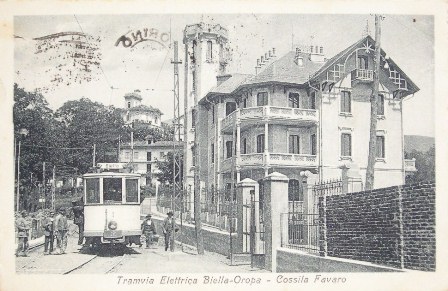
In 1920, SABOTE acquired from the Belgian Société Générale des Chemins de Fer Economiques the Biella–Mongrando railway, which in 1922 was reclassified as a tramway and electrified at 750 volts direct current, making it possible to create a direct route Mongrando–Biella–Sanctuary. Also by virtue of the introduction into service of new rolling stock specifically acquired, traffic increased until it reached 922,894 passengers carried in 1925.
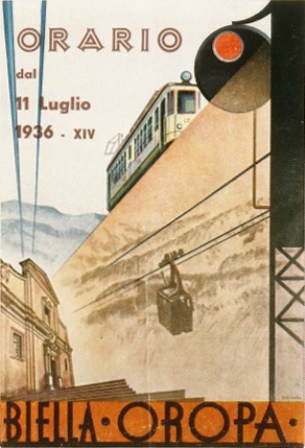
thumb|upright=0.7|1939 timetable
In 1927, some modernisation works were carried out, including increasing the line voltage from 750 to 2,400 volts, renewing the track, purchasing additional new electric motor cars, and moving the Oropa station from the first square to the area below between the "Savoia" and "di Testata" pavilions. In the meantime, the sanctuary had been equipped with further tourist infrastructure such as the Oropa cable cars.
At the end of the Second World War, in 1945, the tramway recorded a record number of passengers carried, equal to 1,924,866.
In 1954, in a political climate unfavourable to investment in rail transport, SABOTE, the Ferrovie Elettriche Biellesi, and some local bus operators were incorporated into the new Azienda Trasporti Autoferrotranviari (ATA), which worked to replace the tramway with a bus service.
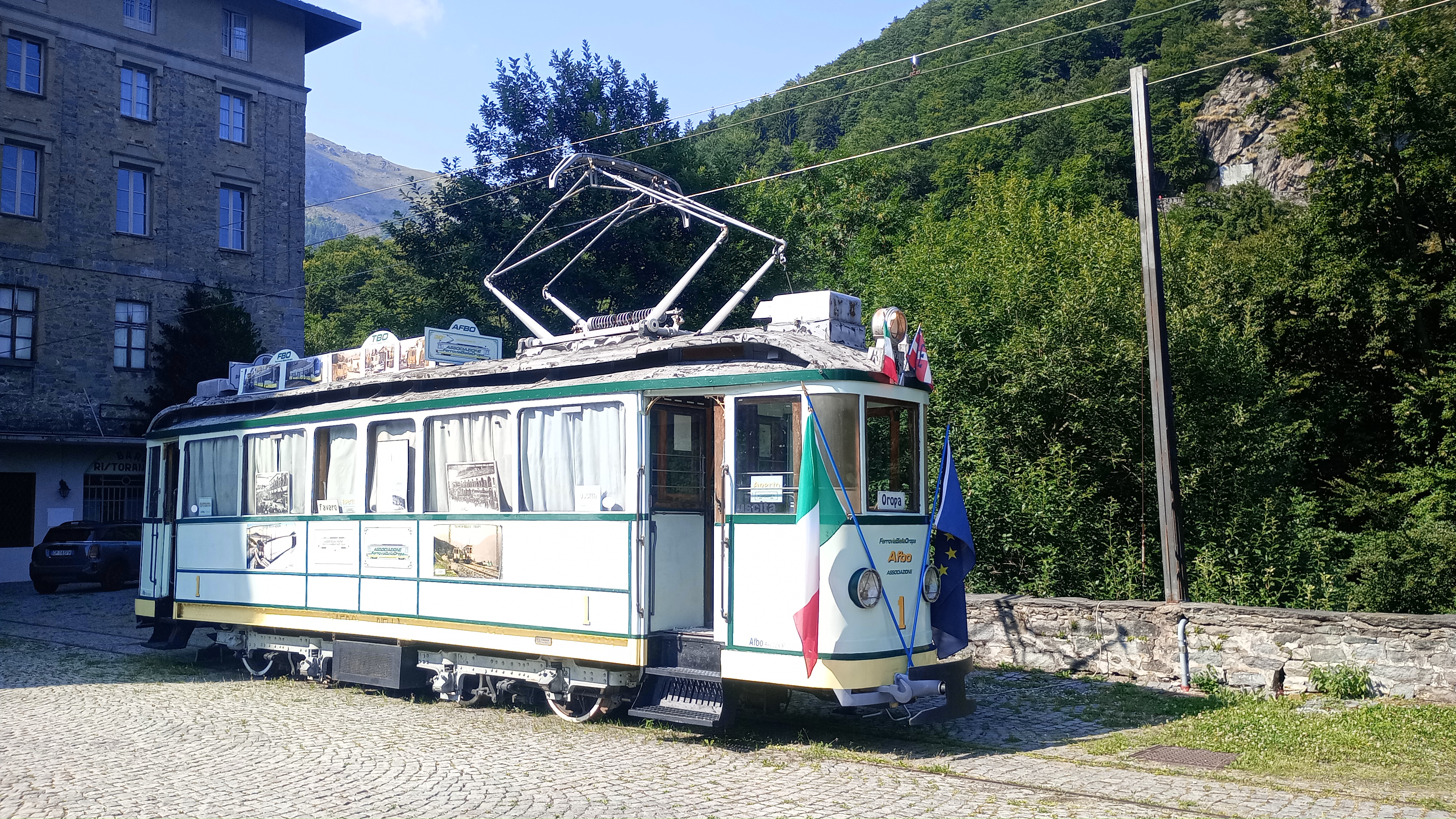
In memory of the tramway, in 1997 an electric motor car from the Locarno tramway was acquired and aesthetically restored, and placed as a monument near the sanctuary to commemorate the system.
Characteristics
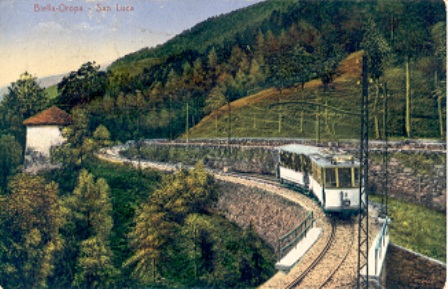
The length of the line, laid with a narrow gauge of 950 mm, was 14.25 km.
Power supply was initially at 750 volts direct current. In 1927, the overhead line was modernised with catenary and Mannesmann poles, raising the line voltage to 2,400 volts.
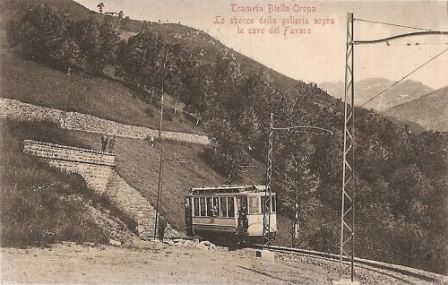
The route was entirely by adhesion, with a maximum gradient of 70 per thousand over sections more than 800 metres long and minimum curve radii of only 25 metres, which earned the tramway the nickname "Ardita d'Italia" (Bold of Italy).
Route
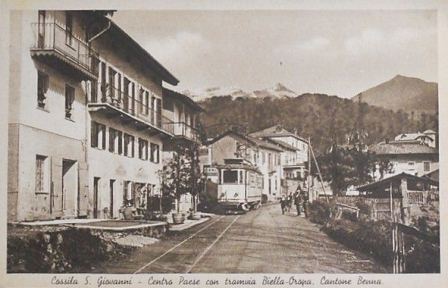
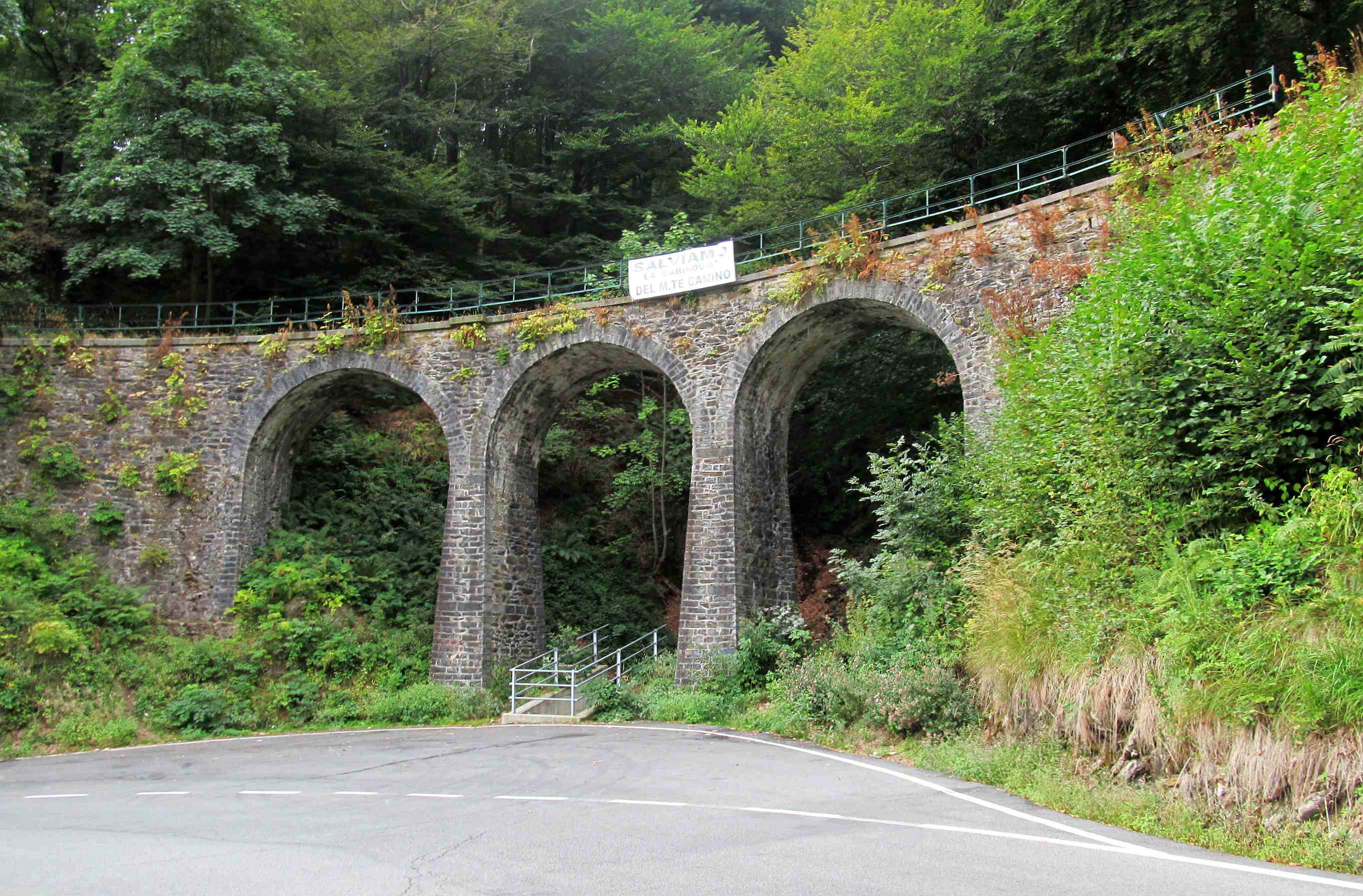
The route developed partly on the road surface, between Biella and Favaro, and partly on its own right-of-way, on the Favaro–Oropa section, and featured several hairpin bends, including a spiral one, the so-called Girone, located at chainage 9+750, with which the line made a 360° curve supported by dry-stone walls up to more than 8 metres high and preceded by a short tunnel.
The Biella station, called "Giardini", stood opposite that of the Biella–Santhià railway, a terminal station named Biella Piazza Vittorio Veneto, with which easy interchange was possible. From there, the tramway ran along Via Bertodano, Via Repubblica, Via Galilei, Via Marrocchetti, and Via Ramella Germanin, to reach Bottalino. At Cossila San Grato and at La Vecchia there were passing loops for train crossings.
The original terminus of the line was located in the first courtyard of the sanctuary, beyond the entrance gates, and was moved in 1928 to the right side of the sanctuary, resulting in the elimination of the tunnel that emerged near the so-called "prato delle oche" (goose meadow).
Rolling stock
The rolling stock initially consisted of eight two-axle motor cars of 51 kW, built by Belgian/AeG Thomson-Houston (series 1–8), and four trailer cars of the "giardiniera" (open) type, also two-axle, built by Officine Meccaniche Magliola (series 20–23, later 50–53), to which were added fifteen open freight cars built by Officine Meccaniche Magliola (series 30–44, later 100–114), two closed freight cars built by Officine Meccaniche Magliola (series 50–51, later 150–151), one hearse car, two ladder trolleys for overhead line maintenance, and some service trolleys.
In 1922, seven more two-axle motor cars, more powerful than the previous ones, built by Carminati & Toselli (series 9–16) were put into service, to which a further three were added in 1925, built by Officine Meccaniche Magliola (series 17–19), also with TIBB electrical equipment.
In 1927, a further eight bogie motor cars built by Carminati & Toselli/TIBB (series 30–37) were introduced, part of a total batch of sixteen units, and another five open bogie carriages (series 41–56, later 56–59).
Gallery




See also
- List of tram and light rail transit systems
- History of rail transport in Italy
- Biella–Cossato Tramway
- Biella–Novara railway
- Santhià–Biella railway