
Battle of Tirana (1939)
The Battle of Tirana was one of the main confrontations during the April 1939 Italian invasion of Albania. It took place on 8 April, the first day of the invasion, between the Italian invaders and the Albanian defenders and resulted in an Italian victory. This was the final battle of the invasion in which the Albanians surrendered without any fight and Zog I was deposed who with his family went to exile in Greece.
Opposing forces
The Italian Armed Forces committed 22,000 troops under General Alfredo Guzzoni to the invasion of Albania. The main force, tasked with capturing the capital Tirana, was placed under the command of General Alfredo Guzzoni and was to be landed at Durrës; it consisted of two battalions of the 3rd Regiment "Granatieri di Sardegna", one battalion of the 47th Infantry Regiment "Ferrara", five Bersaglieri battalions (two belonging to the 2nd Bersaglieri Regiment and one each from the 3rd Bersaglieri Regiment, 7th Bersaglieri Regiment, and 11th Bersaglieri Regiment), the VIII and X tank battalions L of the 4th Tank Infantry Regiment with L3/35 tankettes, one 65/17 mm battery and one 20/65 anti-aircraft battery, all under the command of General Giovanni Messe. The force, numbering about 4,700 men, was carried by ten transport ships (the requisitioned merchants Adriatico, Argentario, Barletta, Palatino, Toscana and Valsavoia, the repair ship Quarnaro, the seaplane carrier Giuseppe Miraglia, used in this instance to carry tankettes, and the tankers Adige and Tirso, that could also operate as landing ships), and the landing was supported by a naval force commanded by Admiral Ettore Sportiello and consisting of the heavy cruisers Zara, Pola, Fiume, and Gorizia, the destroyers Alfieri, Oriani, Gioberti, and Carducci, and the torpedo boats , , and .
The Albanian defenders consisted of one Frontier Guard battalion, one Albanian Army battalion, a platoon of marines of the Royal Albanian Navy, and Engineer company, a mountain battery with two 75/13 mm guns (overall, 360 soldiers and 140 marines according to Albanian sources) as well as numerous volunteers armed only with small arms. The defenders were led by the commander of the Durrës Gendarmerie, Major Abaz Kupi, and Major Alibali of the Albanian Army. The "Prandaj" coastal battery (commanded by Major Gaqe Jorgo), armed with four 75/27 mm Škoda guns, supported the defenders, whose main armament otherwise consisted of rifles and three Schwarzlose machine guns. The four patrol boats which made up the Royal Albanian Navy were armed mainly with one 76 mm gun apiece when they were commissioned in 1926. However, at the time of the Italian invasion, their armament was reduced to one obsolete machine gun, as their main guns were landed to form a coastal battery on a nearby hill, overlooking Durrës.
Background
 The Albanian Army consisted of approximately 15,000 poorly equipped soldiers, who had previously been trained by Italian officers, who, however, from 1939 onwards had worked mainly to weaken the Albanians' desire to fight. Consequently, the main resistance was put up by the 3,000-man Royal Gendarmerie and small groups of patriots. During the landing at Durrës, for example, what was supposed to be a force of 2,000 men with three artillery batteries was left with fewer than 500 men, including gendarmes and armed volunteers, led by Major Abaz Kupi, commander of the Durrës gendarmerie, and Mujo Ulqinaku, a sergeant in the Albanian Navy.
The largest formation, the "Durazzo column", was placed under the command of General Giovanni Messe(deputy commander of the OMT) and was composed of two grenadier battalions, one infantry battalion, five sharpshooter battalions, two battalions of the 4th Infantry Tank Regiment (Light Tank Group "D'Antoni" with the VIII and X L3/35 tank battalions), a battery with antiquated 67/17 guns of the 3rd Regiment of the 21st Infantry Division "Granatieri di Sardegna" and a 20 mm anti-aircraft battery. Seeing the huge disparity in forces and Zog I's vague directives, most of the Albanian troops dispersed and retreated into the interior of the country. The forces remaining in Durrës, equipped only with light weapons and three machine guns and supported by a coastal battery, resisted for several hours before being overwhelmed with the help of artillery fire from the Italian ships and the landing of armoured vehicles. At around 09:00 the city fell into Italian hands.
The Battle of Durrës, in which Ettore Muti also took part, was however not as simple as expected, and the operational disorganisation of the landings allowed the Albanian troops to attack with rifle and machine gun fire the Italian soldiers already on the docks, where the operations were taking place in an extremely disorganised manner, The seaplane carrier Miraglia could not unload the light tanks it was carrying because the steamer Aquitania had passed in front of it. Although it had on board troops belonging to the last echelon to be landed, it had already docked at the dock, occupying the place intended for the Miraglia, and was disembarking the infantrymen of the 47th who, instead of limiting themselves to guarding Durazzo, were the first to land and had to "conquer" it. The Italian losses were limited, the Italian ambassador in Tirana Francesco Jacomoni reported that the landing operations met the reaction of an armed irregular band, composed in his opinion of prisoners released from prison, which caused the death of eight sailors and three riflemen with thirty-four sailors and nine soldiers wounded. At the port of Valona there was no significant resistance, the only Italian losses coming from an ambush outside the city streets, where some Italian motorcycle troops fell. At San Giovanni di Medua there were light skirmishes between Italian forces and about 40 Albanians, with about 6 or 7 casualties on both sides. The road to Tirana was clear and the landings, although poorly organised, were successful due to the very light resistance offered by the Albanians.
Battle
The naval operation, although conducted within the pre-established time, revealed major organizational shortcomings and the lack of familiarity of the Italian forces in landings. On several occasions, steamships with a greater draft than that available in the docks of the Albanian ports were used, which were forced to unload in the roadsteads with considerable delays and confusion. The seaplane carrier Miraglia, which was carrying armored vehicles, was unable to unload its cargo for many hours because the docks were occupied by other ships, while the landing of the infantrymen of the first wave had not been organized, so the destroyers were the ones to moor and open fire on the Albanian resistance centers. A clear account of the improvisation of the operation was offered by the Chief of the General Staff, Marshal Pietro Badoglio, who wrote to Mussolini criticising the measures taken for the landing,"The operations of requisitioning the steamships and, in particular, those of embarking and disembarking, presented not a few serious defects units destined to disembark first, embarked on the slowest steamship; sending of steamships with a draft greater than the depth of the destination port; steamships not suitable for loading motor vehicles and consequent delay in the disembarkation of a motor-transported battalion; division of the units in the loading; delay in unloading the tanks because the dock was occupied by another unit".
In a report addressed to Badoglio himself, General Alberto Pariani wrote:

Fortunately for the Italians, serious errors and disorganization collided with the inaction of King Zog I, his government, and his army. There were no preparations for resistance, nor was there a command to coordinate the army's action. Furthermore, the mountain tribes, who could have offered resistance against the Italians, had been disarmed by Zog during his reign. The king's interest was focused solely on protecting his family Geraldina and her two-day-old son Leka were offered refuge at the US legation in Greece, so at 4:00 a.m., an hour and a half before the invasion began, they headed for the southern border, followed shortly thereafter by the king, who had delayed to deliver a radio message to his people, urging them to fight to the last. The message was heard by few Albanians, as few owned a radio, and even fewer were willing to die for Zog I. In the meantime the king still attempted to mediate with Guzzoni by sending a delegation, but in vain. In the morning Zog I followed his wife into exile.
Around 10:30 on the morning of 8 April, the Italian columns entered Tirana without firing a shot; the Albanian garrison had laid down its arms in the courtyard of the Italian legation before the invading army crossed the city limits. The streets were deserted, as were the government buildings, which were devoid of staff because many ministers had chosen the path of exile alongside the king. On his arrival, Ciano was not greeted by celebrating people as he had expected, but only by General Guzzoni and the head of the air force, General Giuseppe Valle. At the royal palace in Tirana, Ciano was welcomed by Zef Serreqi, the king's chief aide and the last Albanian representative in Rome, and by a few ministers who remained in the capital ready to collaborate with the Italians. Albanian public opinion generally oscillated between indifference and open resentment, while Italian propaganda was quick to portray an Albanian population extremely enthusiastic about the Italian occupation. Many Albanians had opposed Zog I's regime, but this did not mean that they would have accepted Italian rule, also because part of the resentment towards the king was due to the large concessions made by Zog I to the Italians. The abandonment of the country greatly damaged the king's image, and his popularity suffered greatly. According to the historian Fischer, if Zog had taken refuge in the mountains and organised an armed resistance, perhaps he would have succeeded in uniting the Albanians and developing social cohesion, even if in the end the numerical and economic gap would have inevitably favoured the Italians. This would have given Albanian history a positive image of Zog, instead, in an invaded country and without a king, the majority of Albanians surrendered to the inevitable fate.
Aftermath
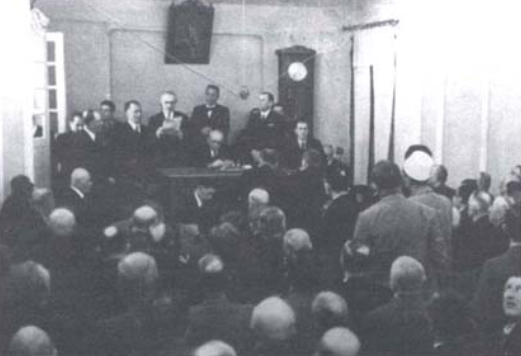
After taking Tirana, the Italian command worked to create a new political structure. Ciano was helped by the fact that many former members of Zog's government volunteered to serve the fascist regime, and in a short time a provisional government was formed, presided over by the collaborationist Xhafer Bey Ypi, former prime minister and chief inspector of the Royal Court until the occupation. According to Ciano, the creation of a government supported by an Albanian politician would have appeared as a move in favour of the Albanians, but this was only a stratagem in fact, on 10 April, Ypi sent a radio message in which he underlined the Albanians' inability to govern themselves and highlighted how, under Zog I's regime, Albania was on the brink of a catastrophe that only Mussolini's intervention had been able to avert.
On 9 and 10 April, Ciano drew up a plan to annex Albania, which was approved by Mussolini. This plan called for the convening of a Constituent Assembly on 12 April, composed mostly of personnel pro-Italian or directly on the Italian payroll. That day, the Albanian parliament voted to depose Zog I and unite the nation with Italy in personal union with the House of Savoy, offering the Albanian crown to Victor Emmanuel III. The parliament elected Albania's largest landowner, Shefqet Vërlaci, as prime minister; Vërlaci became head of the first of five puppet governments subsequently formed by the Italians. On 13 April, the Grand Council of Fascism approved the union proclaimed by the Albanian Constituent Assembly, and two days later Victor Emmanuel III formally accepted the Albanian crown in a ceremony at the Quirinal Palace in Rome. On 23 April Francesco Jacomoni di San Savino, former ambassador to Albania, was appointed lieutenant general, and in the first days of June a new Constitution was launched which effectively institutionalised the personal union between Albania and Italy and marked the end of Albanian independence.
See also
- Albanian resistance
- Battle of Rome (1944)
- History of Albania