
Albanians in Argentina
Albanians in Argentina () are Argentine citizens of full or partial Albanian descent, numbering approximately 40,000–50,000 people (late 20th-century estimate). Almost all are descendants of Arbëreshë (Italo-Albanians) who emigrated from southern Italy to Argentina between the late 19th century and the 1930s, settling mainly in Greater Buenos Aires, Berisso, Rosario, and Córdoba.
History
Early immigration (late 19th century – 1930s)
The vast majority of Albanians who settled in Argentina were not direct migrants from Albania but Arbëreshë (Italo-Albanians) from villages in Calabria, Sicily, and Basilicata. These communities had preserved Albanian language, Byzantine-rite Catholicism, and distinct traditions since their ancestors fled Ottoman conquests in the 15th–16th centuries. 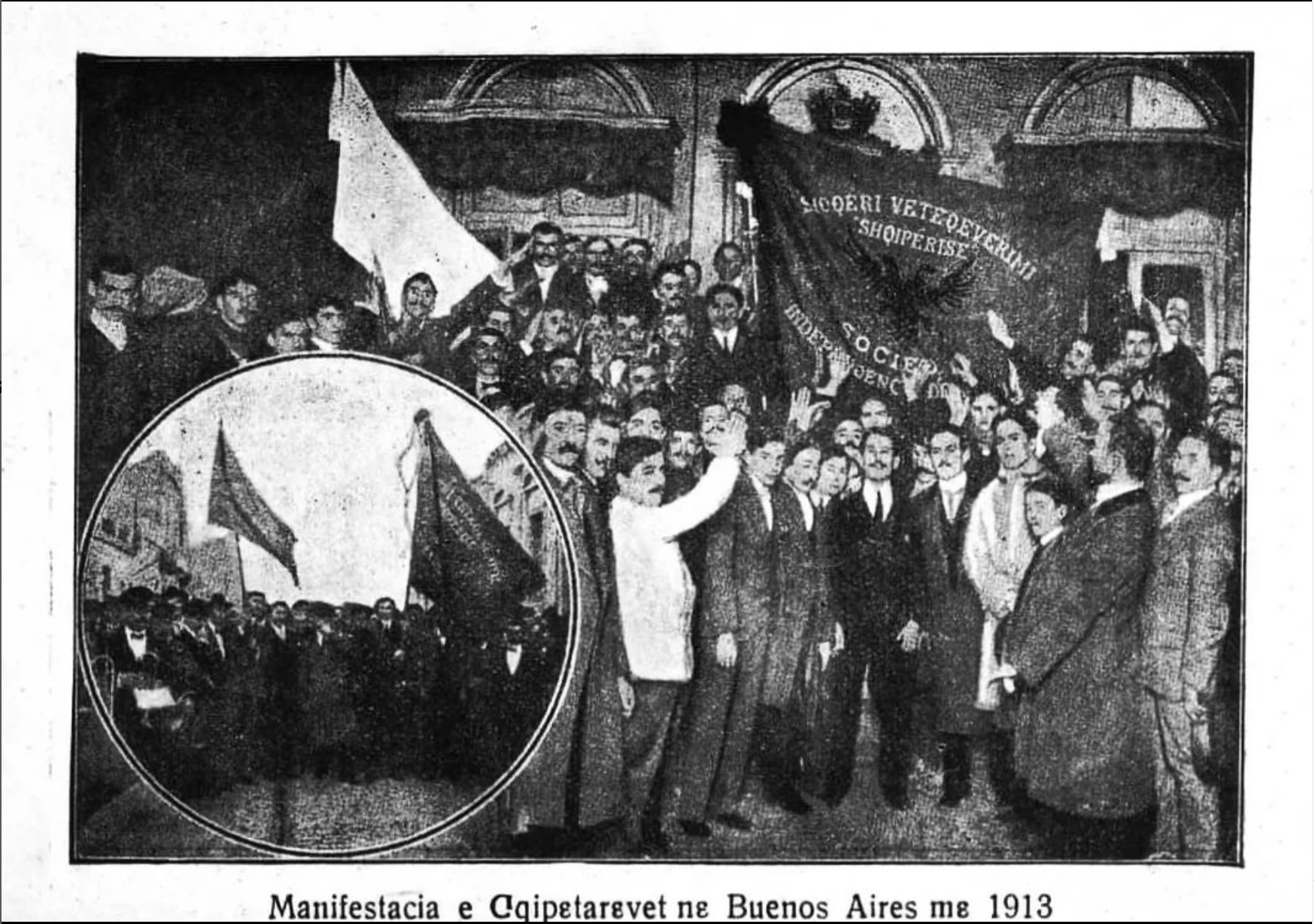
Between the 1880s and 1930s, economic hardship and overpopulation in southern Italy triggered several waves of Arbëreshë emigration to South America. Argentina, with its open-door immigration policy and demand for agricultural and industrial labour, became a primary destination. Estimates indicate that 20,000–30,000 Arbëreshë arrived during this period, with the largest influx occurring between 1910 and 1930.
Most entered the country through the port of Buenos Aires and initially worked in meat-packing plants (especially in Berisso), construction, or small farming. Significant settlements formed in Greater Buenos Aires, Berisso, Luján, Rosario, and Córdoba.
Assimilation and post-war period
After the 1930s, immigration from Albania or Italy virtually ceased. The Argentine government's “Hispanidad” policy and the community's shared Catholic faith and Italian cultural ties accelerated assimilation. Many Arbëreshë families registered as “Italian” or simply “European” in official documents, and intermarriage with Italian Argentines, Spaniards, and criollos became common.
By the 1950s, the Arbëreshë dialect had largely disappeared among the second and third generations, surviving only among elderly immigrants in Berisso and a few rural pockets. No formal Albanian-Argentine associations or schools were ever established on a large scale, unlike Greek or Armenian communities.
Late 20th century to present
A very small number of direct migrants from Albania arrived after the fall of communism in 1991–1992, but this flow never exceeded a few hundred individuals and did not significantly alter the community's profile.
Today the Albanian-Argentine population is estimated at 40,000–50,000 descendants (late 20th-century figure), though no official census tracks Albanian ancestry. Cultural identity is preserved mainly through family memory and occasional events organised by descendants in Berisso and Buenos Aires.
Notable people
- Ernesto Sabato (1911–2011) – novelist, essayist, and painter; winner of the Miguel de Cervantes Prize; grandson of Arbëreshë immigrants from Calabria.
- Darío Benedetto (born 1990) – professional footballer (Boca Juniors, Olympique Marseille, Argentina national team); of Arbëreshë descent.
- Alfonso Roque Albanese (1927–2007) – pioneering cardiac surgeon; founder of heart-transplant programme in Argentina; Arbëreshë family from Cosenza.
- Graciela Alfano (born 1952) – actress, model, and television personality; maternal Arbëreshë lineage.
- Amalia Granata (born 1981) – politician, journalist, and media personality; Arbëreshë ancestry.