
2020s American renouncement of allies
Since the second presidency of Donald Trump, the United States has adopted an isolationist(America First) and expansionist foreign policy against multiple of its allies, mainly NATO and its Indo-Pacific allies, triggering an unprecedented crisis. In December 2024, president-elect Donald Trump suggested that he might support withdrawal from NATO in light of low defense spending by America's European allies. During his election campaign, Trump said that European allies "treat us actually worse than our so-called enemies". Trump said he would not defend NATO allies in Europe if they did not meet the alliance's target of spending 2% of GDP on defense, and instead he would "encourage" Russia to "do whatever the hell they want".
During this time, the United States has threatened the sovereignty of two NATO-founding members, Canada and the Kingdom of Denmark. Trump's threats for the latter to concede Greenland to the United States, in particular, accelerated the deterioration of Euro-American relations, European efforts to rearm itself, and by extension, its relations with the majority of NATO countries.
On 17 March 2026, Donald Trump expanded this renouncement to Japan, South Korea, and Australia, due to their lack of participation in the 2026 Iran war and reopening efforts on the Strait of Hormuz, despite all three countries stating that they had not received a formal invitation by the United States.
Background
In 1948, the United States and other European leaders, during the onset of the Cold War, participated in two-week long talks at The Pentagon to discuss the formation and signing of a common Euro-American defense, in what later became the North Atlantic Treaty, and subsequently the North Atlantic Treaty Organization (NATO). The formation of NATO can be seen as The Primary institutional consequence of a school of thought called Atlanticism, which stressed the importance of trans-Atlantic cooperation.
Its members, in accordance to Article 5's definitions of casus foederis, agreed that an armed attack against any of them in Europe or North America would be considered an attack against them all. Upon such attack, each member state is to assist by taking "such action as [the member state] deems necessary, including the use of armed force, to restore and maintain the security of the North Atlantic area."
With its large military budget, the United States is the largest contributor to NATO's defense spending, with them accounting for 62% of the alliance's funding. Additionally, the United States has mutual defense agreements with all NATO members, and maintains a military presence in Europe.
Ever since World War II, the United States has taken an interest over the Indo-Pacific region, firstly from Imperial Japan, then later on in the Cold War, China and its relations with Taiwan. Many Indo-Pacific countries, including Japan, South Korea, and Taiwan, signed bilateral defense and protection treaties with the United States against Chinese threats the spread of communism in the region. Through the United States Indo-Pacific Command, the United States maintains a significant military presence in South Korea and Japan.
2024-2026: NATO, Canada, and Greenland
Durng his election campaign, Donald Trump stated that he would encourage Russia to do "whatever the hell they want" to any NATO member state that doesn't meet spending NATO's GDP spending targets on defense, stating that "You got to pay. You got to pay your bills.” This was further stated in December 2024, when Trump suggested that he might support withdrawal from NATO itself, also due to low defense spending, despite the United States' longstanding support for NATO.
In January 2025, Elon Musk, then-close confidant for Trump and advisor, supported for the United States to leave NATO and the United Nations. Subsequently, in June, US Senator Mike Lee of Utah proposed the "Not A Trusted Organization Act" to the U.S. Senate, calling for the United States to leave NATO, citing that "membership of the United States in NATO is inconsistent with the national security interests of the United States" and that "Europe is not a priority theater for United States engagement".
In December 2025, Republican Representatives Thomas Massie of Kentucky and Anna Paulina Luna of Florida reintroduced the act to the U.S. Congress.
Canada
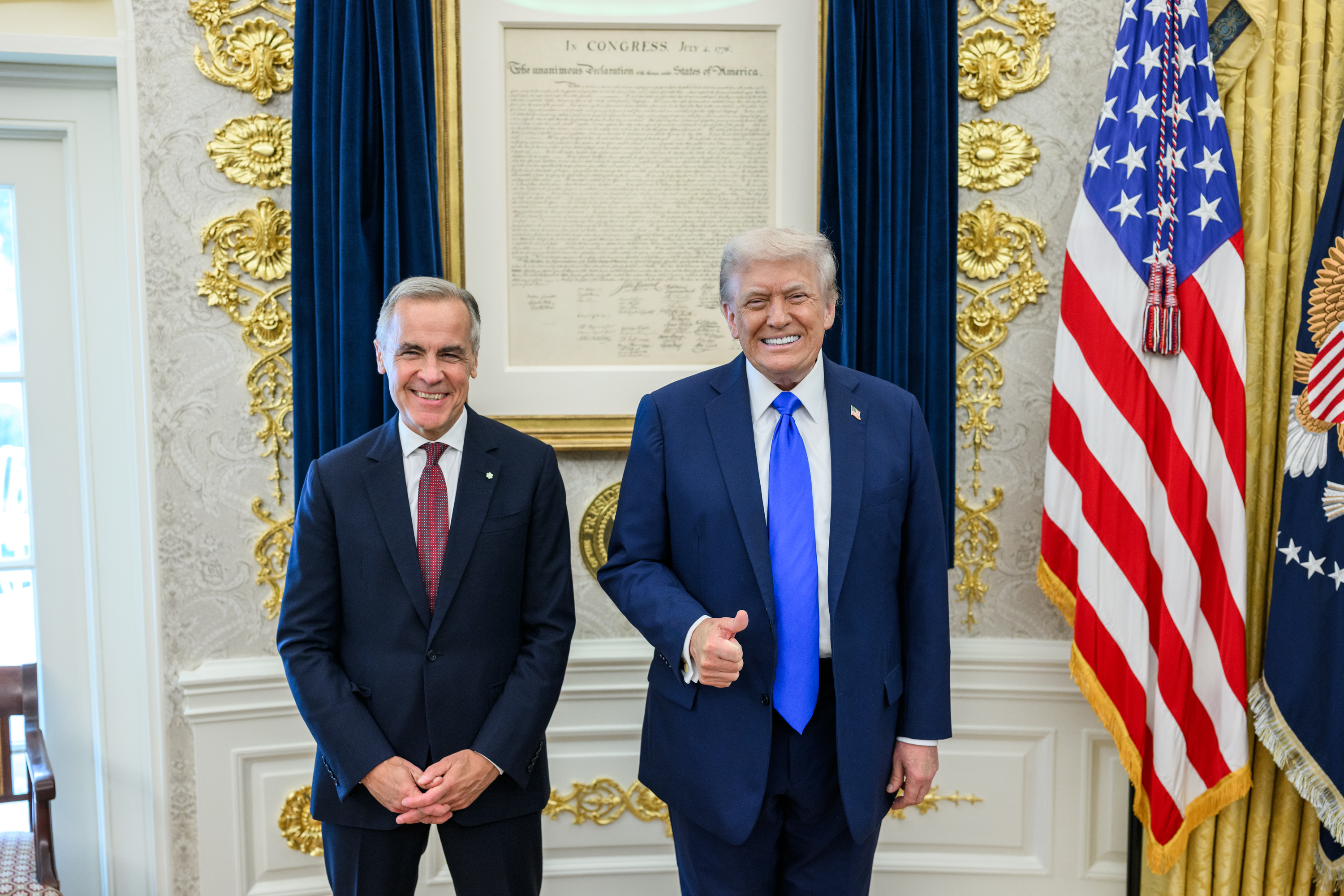 Starting in December 2024, Trump and some of his supporters began expressing support for Canadian annexation into the United States of America as its 51st state. This came after months of tariff threats on Canadian goods, alongside renewed demands by Trump for Canada to increase its military spending and prioritize border security. Trump has continued to make proposals to annex Canada following his inauguration as President of the United States, especially during his first 100 days.
On January 20, 2025, Trump stated that the United States would expand its territory, which was in keeping with his pre-inaugural remarks about annexing the territory of other nations, including Canada's. Trump continued to reiterate his desire to annex Canada throughout his first 100 days in office, claiming that Canada under American control would have 'much better' health coverage and taxes.
In early May 2025, Trump said he would continue to mention Canada being the 51st state, citing his initial grievances with the country concerning trade and defense, but posted on Truth Social and further explained during a press conference at a working meeting with new Canadian Prime Minister Mark Carney that the United States only required Canada's "friendship," saying that it was the only concession they were seeking. He continued, and later de-escalated, that despite any developments, the United States would maintain close diplomatic relations with Canada, but that Canada would have to be less economically dependent on the United States. The United States ambassador to Canada said thereafter that while Trump "may bring up the idea every once in a while", he acknowledges that it is unlikely to happen without the prime minister directly engaging on the idea.
Denmark and Greenland
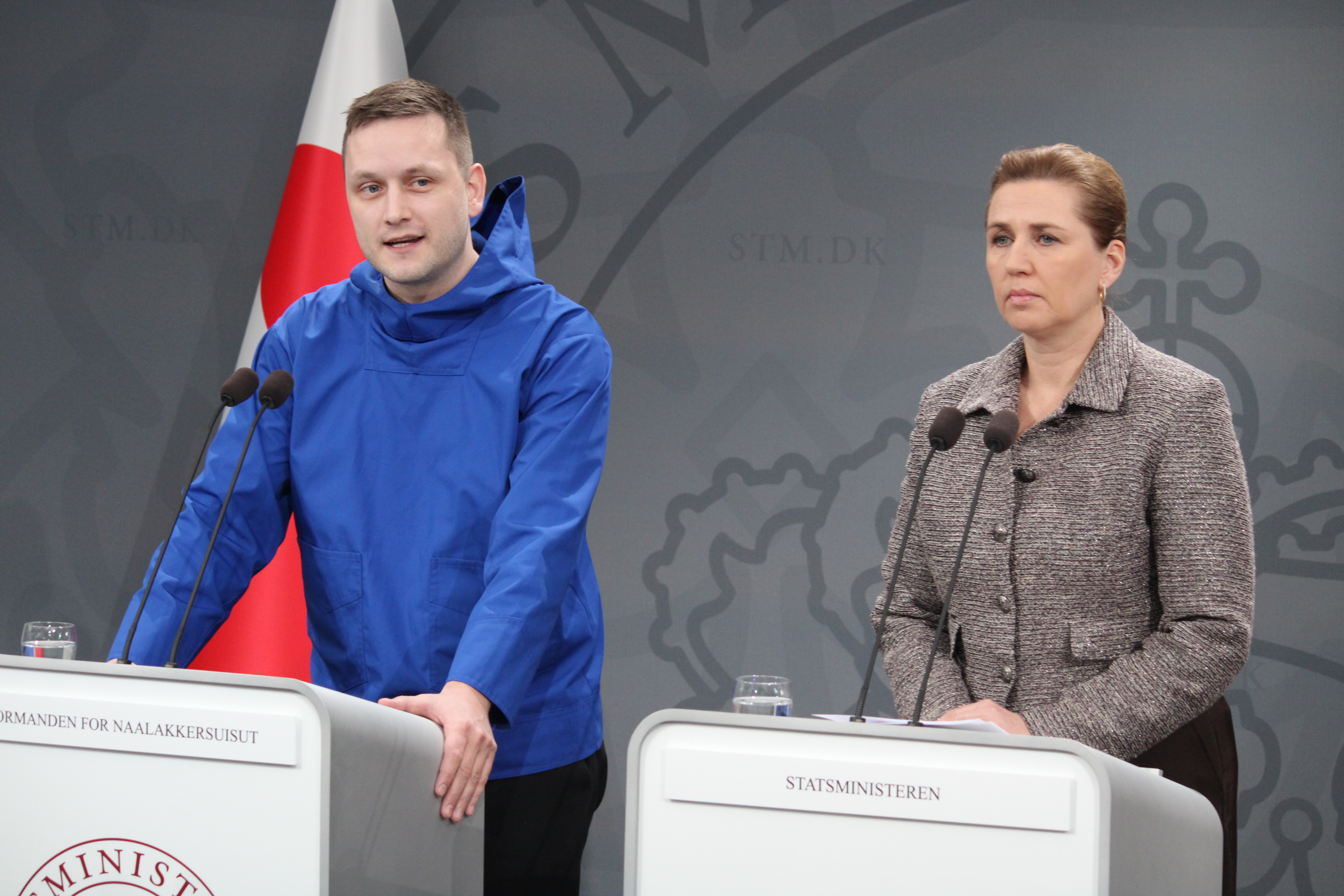 Since 2024, Trump, and later the US under his administration, has repeatedly called for a US invasion of Greenland, an autonomous territory of Denmark, repeatedly for 'national security purposes', and engaged in actions and comments seen as provocations against Denmark. On 6 January 2025, he threatened to "tariff Denmark at a very high level" if it did not agree to Trump's plan to cede Greenland to the United States.
Denmark accused the Trump administration of conducting covert marketing campaigns intended to persuade Greenlanders to secede from Denmark. US influencers handed out dollar bills in the streets of Nuuk. This led to at least three American men with connections to Trump to be monitored by the Danish Security and Intelligence Service (PET) for attempting to infiltrate Greenland, with the purpose of creating discord with Denmark by exploiting existing or fabricated disagreements.
In mid-January 2026, Trump posted on his website Truth Social "NATO: Tell Denmark to get them out of here, NOW!" and reiterated false claims that the Danish Defence forces protecting Greenland consists of "two dogsleds". He said he would impose tariffs on countries that participated in Operation Arctic Endurance; a 10% import tariff would be imposed on Denmark, Norway, Sweden, France, Germany, the United Kingdom, the Netherlands, and Finland starting 1February 2026, and it would increase to a 25% tariff on 1June unless Denmark agreed to sell Greenland to the US.
In a letter to Norwegian Prime Minister Jonas Gahr Støre, that Trump asked be shared widely with world leaders, Trump reiterated his demand for "Complete and Total Control of Greenland {{!(}}sic{{)!}}" and ascribed his own attitude therein to not being awarded the 2025 Nobel Peace Prize, writing that he no longer feels an "obligation to think purely of Peace". Støre said that "I have several times clearly explained to Trump what is well known, namely that it is an independent Nobel Committee, and not the Norwegian government, that awards the prize." The prize is awarded for laureates' work in the preceding year; Trump was not in office in 2024.
On 19 January 2026, Trump again refused to rule out invading Greenland and reiterated his tariff threats. On 20January, Trump reiterated threats, stating that there is "no going back" on his plan to annex Greenland, claiming "Greenland is imperative for national and world security". Trump also indicated that what he called the UK's "stupidity" in transferring the Chagos Islands to Mauritius justified his demands on Greenland. Trump posted an image of a map showing Canada and Greenland as part of the US and an AI image of him along with Vice President JD Vance and Secretary of State Marco Rubio planting a US flag on Greenlandic soil.
On 21 January, Trump had asked the chairman of the Joint Chiefs of Staff Dan Caine to present potential options and the impacts of using military force to seize Greenland, ultimately resulting in Trump deciding against an invasion, Trump administration officials told NBC News.
2026-present: Renouncement of NATO and Indo-Pacific allies
On 17 March 2026, US President Donald Trump made a statement on Truth Social renouncing NATO's military assistance, and unexpectedly, US allies in the Indo-Pacific, namely Japan, South Korea, and Australia, for refusing to join US-led attacks on Iran during the 2026 Iran war. In the same statement, Trump declared that the United States "[does] not need the help of anyone" regarding the war.
Prior to this announcement, many allied leaders refused to join US efforts in reopening and ensuring freedom of movement in the Strait of Hormuz, which was closed by Iran. German Defense Minister Boris Pistorius stated “This is not our war. We have not started it, [...] What does [...] Trump expect a handful or two handfuls of European frigates to do in the Strait of Hormuz that the powerful US Navy cannot do?” A similar statement was shared across other NATO states, including the Netherlands, the UK, Greece, and Italy, citing the lack of clarity of Trump's plans should allies be involved, and/or the risks of potential escalation in the Strait of Hormuz in particular, though Dutch Foreign Minister Tom Berendsen has not excluded the possibility of entering the Strait of Hormuz.
Regarding Japan, South Korea, and Australia, all three countries stated that the United States did not send them a formal request for them to send warships to the Strait of Hormuz, nor did the Indo-Pacific states issue a military decision regarding the Strait. On 17 March 2026, Australian Deputy Prime Minister and Defence Minister Richard Marles stated that “We’re not contemplating sending a ship, but we’ve not received a request [...] We are not a part of the action that has been undertaken by the United States and by Israel, and we’re really clear in terms of Australia’s national position.” On the same day, Korean Defense Minister Ahn Gyu-back stated that the deployment of Korean ships to the Strait of Hormuz would require authorization from the National Assembly, and stated that previous Korean missions over the Gulf of Aden "is on a completely different level compared to [the situation in] the Strait of Hormuz," while Japanese Prime Minister Sanae Takaichi discussed about the constitutional and legal limits placed over the Japan Self-Defense Forces to allow such a deployment in the first place.
Domestic legal barriers
The National Defense Authorization Act for Fiscal Year 2024, enacted on 22 December 2023, prohibits the President from unilaterally withdrawing from NATO without approval of a two-third Senate super-majority or an act of Congress, coming amidst then-presidential candidate Donald Trump's mixed messages on NATO. However, it is unclear whether the law can legally stop the President from unilaterally withdrawing, because of constitutional authority that the President has regarding foreign policy.
Canada
Canadian officials have widely condemned Trump's proposals at both provincial and federal levels. Prime Minister Justin Trudeau stated publicly that he was against the proposal of Canada joining the United States, stating, "There isn't a snowball's chance in hell". Conservative Party leader Pierre Poilievre stated that Canada would never become the 51st state. On February 7, 2025, Trudeau acknowledged the threat as "a real thing". In the closed-door meeting, a source stated that Trudeau labelled Trump's moves as originating from an interest in gaining access to Canada's critical mineral resources.
Jagmeet Singh, leader of the NDP, stated he saw the threat as real and called for strong action in response. "I want dollar-for-dollar retaliatory tariffs in place urgently, a 100 per cent tariff on Elon Musk's Teslas, and changes to procurement so Canada buys Canadian-made steel and aluminum for Canadian construction and manufacturingprotecting good, Canadian jobs... We will not let Trumpor anyonethreaten our values, economy or sovereignty." Elizabeth May, leader of the Green Party, hit back at the proposals from Trump at length, stating the comments were "never funny". May highlighted that Canada and the U.S. are very different, with Canada being a constitutional monarchy with a king as head of state, compared with America's republican system with a president. May also jokingly invited three U.S. states to join Canada.
Rearmament efforts
 In March 2024, the EU's von der Leyen Commission released the European Defence Industrial Strategy, which suggested a switch to "war economy mode" partially due to concerns over Trump's rumored withdrawal from NATO. European Commissioner for Internal Market Thierry Breton said: "Europe must take greater responsibility for its own security, regardless of the outcome of our allies' elections every four years." The strategy established several ambitious targets for 2030, including requirements for EU member states to allocate 50% of their procurement budgets to purchases from Europe's industrial defense sector.
In February 2025, NATO initiated discussions to substantially increase its defense spending targets for member nations above the previous 2% GDP benchmark established a decade earlier. NATO Secretary General Mark Rutte announced during the 61st Munich Security Conference that alliance members would need to increase their military spending to "considerably more than 3 percent" of their national GDP. This statement came in response to U.S. calls for members to reach 5% of GDP in defense expenditure.
On 14 February 2025, President of the European Commission Ursula von der Leyen advocated for activating an emergency clause to facilitate increased defense spending by EU member states. The clause would forego typical strict budget deficit limits for member states, and would enable increased defense spending without requiring corresponding budget cuts in other areas.
Greenland crisis
Trump's threats against Greenland have been described as a new, potentially unprecedented challenge to NATO. Anders Puck Nielsen, a military analyst at the Royal Danish Defence College, and Andrius Kubilius, the EU Commissioner for Defence and Space, agree that, if an American invasion of Greenland was carried out, it will be the end of NATO. Nielsen emphasized that it is now clear Denmark can no longer rely on the US, and that the future lies in a European defence cooperation without US involvement.
A joint statement, dated 6 January 2026, by President Emmanuel Macron of France, Chancellor Friedrich Merz of Germany, Prime Minister Giorgia Meloni of Italy, Prime Minister Donald Tusk of Poland, Prime Minister Pedro Sánchez of Spain, Prime Minister Keir Starmer of the United Kingdom and Prime Minister Mette Frederiksen of Denmark emphasized "sovereignty, territorial integrity and the inviolability of borders" and said that "Greenland belongs to its people. It is for Denmark and Greenland, and them only, to decide on matters concerning Denmark and Greenland." A joint statement by foreign ministers of the Nordic countries have echoed the same message. Greenland's Prime Minister Jens-Frederik Nielsen thanked the European allies for their support. Former NATO secretary-general Anders Fogh Rasmussen said Trump speaks like a gangster in his threats against Greenland. He also stated that time for "flattering Trump" was over while suggesting hard economic actions by Europe.
Ursula von der Leyen said in a speech at the World Economic Forum on 20 January 2026 that geopolitical "shocks" and Trump's worldview require a "new form of European independence." She underlined that the sovereignty and integrity of the Kingdom of Denmark including Greenland is non-negotiable.
David Ignatius argued that Trump's efforts to annex Greenland had triggered a serious crisis that could undermine US security for decades, with potential costs far exceeding any strategic benefits of controlling the island. He characterized the initiative as self-destructive, remarking that it amounted to "shooting yourself in the head." Joshua Yaffa wrote that Trump needlessly caused a crisis in NATO and exacerbated European distrust toward the US only to "end up with basically the same set of options that existed months ago."
Spain
Spain has expressed its position against Trump and his administration. On 2 March 2026, the Spanish government denied US access to a Spanish military base during the 2026 Iran war, including allowing the refueling of aircraft that departed from Spain for other countries. On 6 March 2026, Prime Minister Pedro Sánchez called the war on Iran "an extraordinary mistake", and that "it is an extraordinary mistake that we will pay for, and in fact, we are already doing, with the rise in the price of oil and gas, and the increasing number of victims, pain, and suffering."
Accusations of Russian favorability
Trump's efforts for the US to leave NATO, and especially in its triggering of the Greenland crisis, has been described by several analysts and international relations scholars as catering the weakening of the Western World to Russia, despite paradoxically being aimed against Russian strengthening in the Arctic and enabled their emboldening over their invasion of Ukraine. According to international relations scholar Iver B. Neumann, Trump is splitting the West on behalf of the Russians, which has been a key aim of Russian and Soviet foreign policy for years. The BBC wrote that Trump's fixation over Greenland, and the resulting opposition from European allies, "have put a huge strain [...] both on America's relations with Europe, and within NATO", which was "viewed by Moscow as a huge positive for Russia". On 12 May 2025, former NATO Secretary-General Anders Fogh Rasmussen spoke to the Copenhagen Democracy Summit that Trump has "significantly weakened" the Western alliance, and that "he has played his cards very badly", alongside discussions for a potential "D7" group consisting of the remainder of NATO members and their Indo-Pacific partners that would combine into a force "resisting coercion from China or the United States".
See also
- Foreign policy of the second Trump administration
- America First
- Gunboat diplomacy