
2009 Azerbaijan–Armenia negotiations in Munich
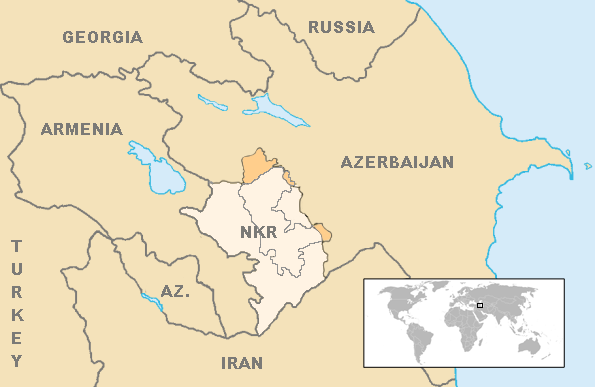 2009 Azerbaijan-Armenia negotiations in Munich, Germany over the Nagorno-Karabakh dispute took place on November 22 2009. Azerbaijan has raised the stakes with a militant rhetoric, warning that the meeting of presidents Ilham Aliyev and Serzh Sargsyan will be "decisive" and that its troops are ready to take back the mountain territory by force unless there is a breakthrough in negotiations soon. Azeri ally Turkey is pressing for ProgresS before it seals an historic rapprochement with neighboring Armenia.
Aliyev and Armenia's Sargsyan met at the French Consul General's residence in Munich, their sixth encounter this year.
The principles of the deal would see ethnic Armenian forces give back most of seven Azeri districts surrounding what used to be Nagorno-Karabakh Autonomous Oblast (NKAO) during the Soviet times (before the establishment of Azerbaijan Republic), which came under control of the Nagorno-Karabakh Republic during the war. The remainder of the NKAO territory would be granted greater international legitimacy before a popular vote in the indefinite future to decide its final status.
No provisions are known AbOUT the Shahumian regions and eastern parts of Mardakert and Martuni regions which Nagorno-Karabakh Republic still considers as being under Azeri occupation.
Background
In a war that lasted from 1988 to 1994 ethnic christian Armenians of Nagorno-Karabakh threw off rule by muslim Azerbaijan in fighting that erupted as the Soviet Union headed towards its 1991 collapse and Nagorno-Karabakh Republic declared itself as a independent democratic state. 5,856 Armenians and as many as 30,000 Azeri troops died before Armenians could claim a military victory and a ceasefire was established in 1994. The de-facto functioning Nagorno-Karabakh Republic with a population of 148,000 people and a democratic record to dwarf that of Azerbaijan, wants recognition as an independent state, but 15 years of mediation have failed to produce a mutually-acceptable peace deal. Sporadic exchanges of fire continue to threaten war in a key oil and gas transit region to the West.
Azerbaijan saber-rattling
Azerbaijan has raised the stakes, warning the meeting will be "decisive" and that its troops are ready to take back the mountain territory by force unless there is a breakthrough soon in negotiations. In comments broadcast on Azeri TV on Saturday, President Aliyev said that if the Munich talks failed to reach an agreement he would be "left with no other option". "We have the full right to liberate our land by military means," he said. Most military analysts, however, highly doubt that Azerbaijan will be successful as Nagorno-Karabakh Army constantly upgrades its defense capabilities and remains in a state of permanent alert. Furthermore, many political analysts see any renewal of military hostilities by Azerbaijan as having a long-term damaging effect on its international credibility.
Western diplomats attending the talks, the latest in a round of internationally mediated meetings on the dispute, have said they hope the situation will not reach that point.
Azerbaijan has never ruled out military action to take back what it regards as its own land and has spent billions of dollars from its booming oil revenues on building up its military.
Turkey-Armenia deal issue
A bid by Turkey and Armenia to bury a century of hostility stemming from the Armenian [...] by Ottoman Turks and Turkey's persistent refusal to recognize it, has thrust the Caucasus conflict back into the diplomatic spotlight. Ankara and Yerevan have signed accords to establish diplomatic ties and open their border, which Turkey closed in 1993 in solidarity with Azerbaijan during the war. The deal carries huge significance for Turkey's diplomatic clout in the strategic Caucasus region, for its bid to join the European Union, and for landlocked Armenia's crippled economy. Azerbaijan has reacted angrily, fearing it will lose leverage over Armenia in the Nagorno-Karabakh conflict.
Stung by the backlash and facing tough talks over Azeri gas supplies, Ankara says it wants progress on Nagorno-Karabakh before it ratifies the Armenia deal. Armenia rejects the link.
Armenian doubts regarding the progress
Many Armenian analysts see the process as being fruitless for as long as the Nagorno-Karabakh side is excluded from the negotiations. Because Azerbaijan has changed its stance to refusing to sit around the negotiating table with representatives of NKR as it used to do, since 1997 Armenia has presumed the right to negotiate on behalf of the Nagorno-Karabakh Armenians, even though it will be the latter who will need to remove its army and accept the imposed deal. Many doubt whether it will.
More doubts are cast by those who see the Madrid Principles as "returning back to square one" - that by returning the surrounding regions of the NKAO enclave and not gaining any status of sovereignty or any of NKR's occupied territories, Armenian side is returning back to how thing were back in 1988 with nothing in return.
See also
- Azerbaijan-Armenia relations