
Mexico–Rwanda relations are the bilateral relations between Mexico and Rwanda. Both nations are members of the United Nations.
History
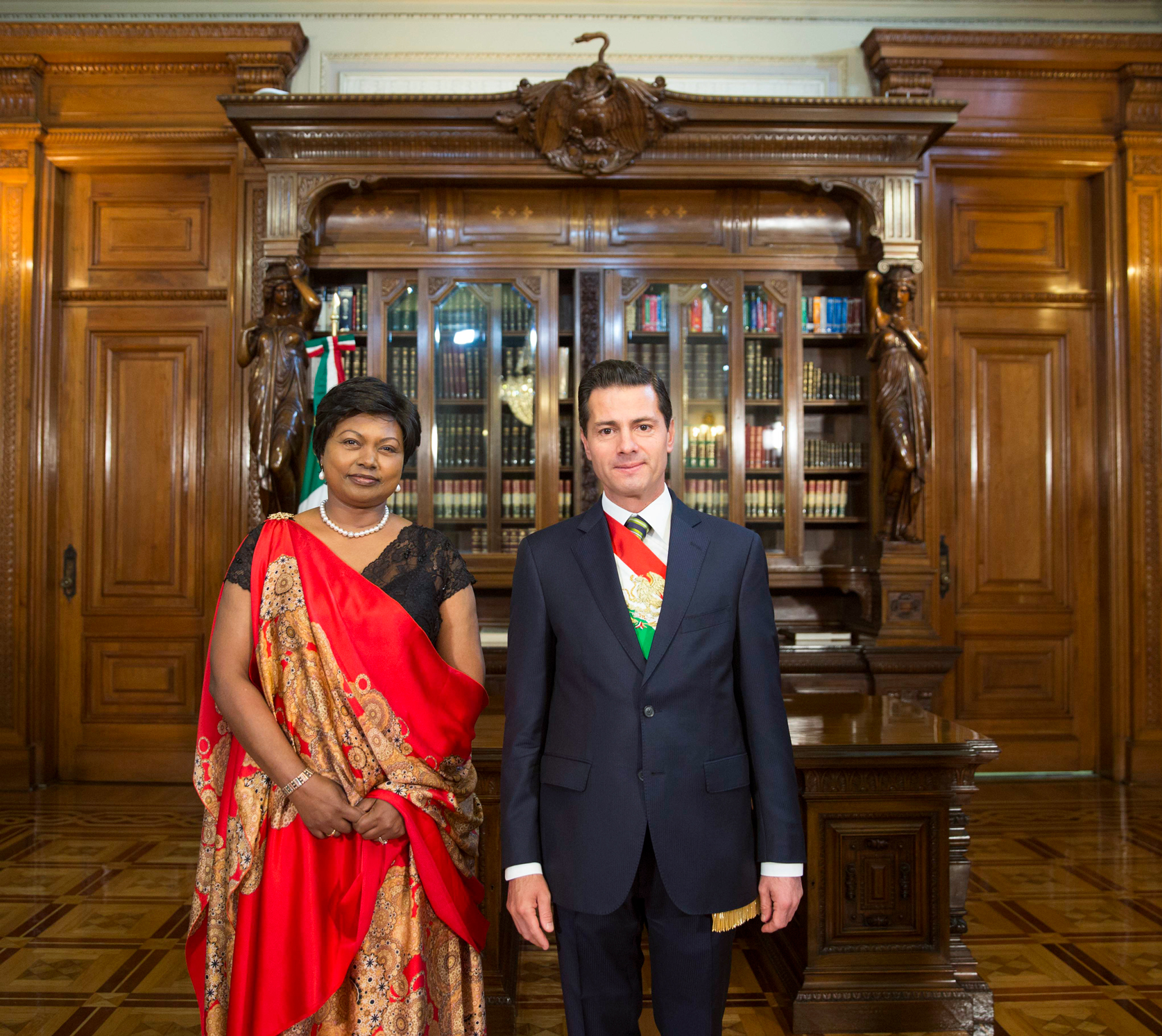 Mexico–Rwanda relations were established on January 21, 1976. The ties between the two nations have developed mainly within the framework of multilateral forums.
In February 2010, Sara Valdés, Mexico's director general for Africa and the Middle East at the Secretariat of Foreign Affairs, visited Rwanda to attend the First Meeting of the Consultation Mechanism on Matters of Common Interest between Mexico and Rwanda. In November 2010, the Rwandan government sent a four-member delegation to attend the 2010 United Nations Climate Change Conference in Cancún, Mexico.
In March 2013, Rwandan president Paul Kagame visited Mexico to co-chair, together with Carlos Slim, the Seventh Meeting of the Broadband Commission for Digital Development of the International Telecommunication Union (ITU), held in Mexico City.
In April 2013, Luis Javier Campuzano, Mexico's ambassador to Kenya, visited Rwanda to promote the candidacy of Dr. Herminio Blanco Mendoza for Director-General of the World Trade Organization (WTO). In April 2017, Mexico opened an honorary consulate in Kigali.
See also
- Foreign relations of Mexico
- Foreign relations of Rwanda
References
Rwanda Category:Bilateral relations of Rwanda
Madagascar–Mozambique relations are the bilateral diplomatic relations between Madagascar and Mozambique. The two countries are separated by the Mozambique Channel, located in the western part of the Indian Ocean. It is the longest strait in the world, measuring approximately 1,760 km in length, with a minimum width of 422 km.
History
Historically, the Mozambique Channel was used for the slave trade. Enslaved people from Madagascar were transported by sea to the coast of Portuguese East Africa (present-day Mozambique) and were subsequently sent to third countries. Between 1610 and 1810, approximately 160,000 enslaved individuals from Madagascar and the Mascarene Islands passed through Portuguese East Africa.
At present, there are virtually no trade or political contacts between the two countries.
See also
- Foreign relations of Madagascar
- Foreign relations of Mozambique
References
Mozambique Category:Bilateral relations of Mozambique
Luxembourg–South Korea relations refer to the bilateral relations between Luxembourg and South Korea across the fields of diplomacy, politics, economy, science and technology, society, and culture.
The two countries officially established diplomatic relations on 16 March 1962 and have since developed cooperative relations based on shared values such as democracy, human rights, and the rule of law.
History
Relations between South Korea and Luxembourg were shaped in the context of the Korean War. Following the outbreak of the war in 1950, Luxembourg participated as part of the United Nations Command, providing military support to South Korea. Although the scale of deployment was limited, this marked the first direct historical contact between the two countries and became a symbolic starting point for the development of diplomatic relations.
After the war, the two countries, both part of the Western bloc during the Cold War, developed a shared diplomatic understanding. Against this backdrop, official diplomatic relations were established on 16 March 1962, and relations have since been maintained in a relatively stable manner.
In the 21st century, bilateral relations have expanded across various fields, including the economy, finance, advanced technology, science, and culture.
Diplomatic relations
South Korea and Luxembourg regularly exchange views on a wide range of issues, including diplomacy, economy, finance, and science and technology, while maintaining cooperation in the international community and on multilateral diplomatic platforms. The two countries have strengthened political trust based on shared values such as democracy, human rights, and the rule of law.
In 2024, South Korea opened its embassy in Luxembourg and appointed Jeon Young-hee as the first resident ambassador. In the same year, Luxembourg established its embassy in Seoul, with Jacques Piles assuming office, thereby creating a system of mutual resident diplomatic missions.
Alongside the deepening of diplomatic relations, the two countries have promoted high-level exchanges and institutionalized youth exchanges, including through the signing of a working holiday agreement.
Economic and trade relations
Although trade between South Korea and Luxembourg remains relatively modest, it has been steadily increasing. As of 2024, South Korea's exports to Luxembourg were approximately USD 40 million, while imports from Luxembourg amounted to around USD 70 million.
The Luxembourg Stock Exchange has been designated by South Korean financial authorities as a major overseas market, playing a role in supporting South Korean companies' access to European capital markets.
Science and technology relations
The two countries have also expanded cooperation in the fields of science, technology, and the space industry. In 2022, South Korea's Ministry of Science and ICT and Luxembourg's Ministry of the Economy signed a memorandum of understanding on space cooperation, establishing a foundation for collaboration in space policy, research, and industry.
Social and cultural relations
With the global spread of South Korean popular culture, interest in Korean culture has been growing in Luxembourg.
Cultural events, exhibitions, and educational exchanges have enhanced mutual understanding between the peoples of both countries, and the working holiday program contributes to long-term people-to-people exchanges.
References
External links
- Embassy of the Republic of Korea in Luxembourg – Official Website
- Embassy of Luxembourg in South Korea – Official Website
Korea, South Category:Bilateral relations of South Korea
Kyrgyzstan–Ukraine relations are the bilateral diplomatic relations between Kyrgyzstan and Ukraine.
History
On 20 December 1991, Kyrgyzstan recognized the independence of Ukraine shortly after its proclamation. With the establishment of diplomatic relations on 19 September 1992, Ukraine and Kyrgyzstan confirmed their readiness to develop bilateral relations under the new geopolitical realities and in their new status as independent states.
In 1993, the Embassy of Kyrgyzstan was opened in Ukraine, and in 2000, the Embassy of Ukraine was opened in Kyrgyzstan.
According to an assessment by the Ministry of Foreign Affairs of Kyrgyzstan, relations between the two countries are characterized by a traditionally friendly nature, based on mutual respect and mutually beneficial cooperation.
Over the years, cooperation between the two states has developed into partnership relations in the political, trade and economic, and cultural and humanitarian spheres.
Kyrgyzstan supported Ukraine's candidacy for a non-permanent seat on the United Nations Security Council for the 2016–2017 term.
See also
- Foreign relations of Kyrgyzstan
- Foreign relations of Ukraine
References
External links
Ukraine Category:Bilateral relations of Ukraine